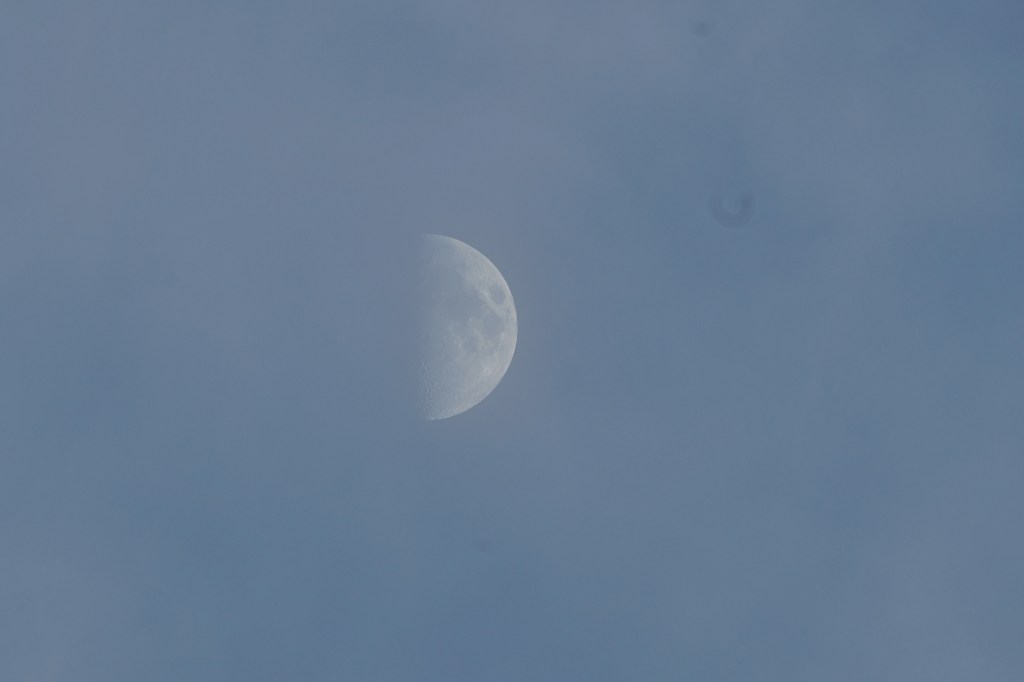
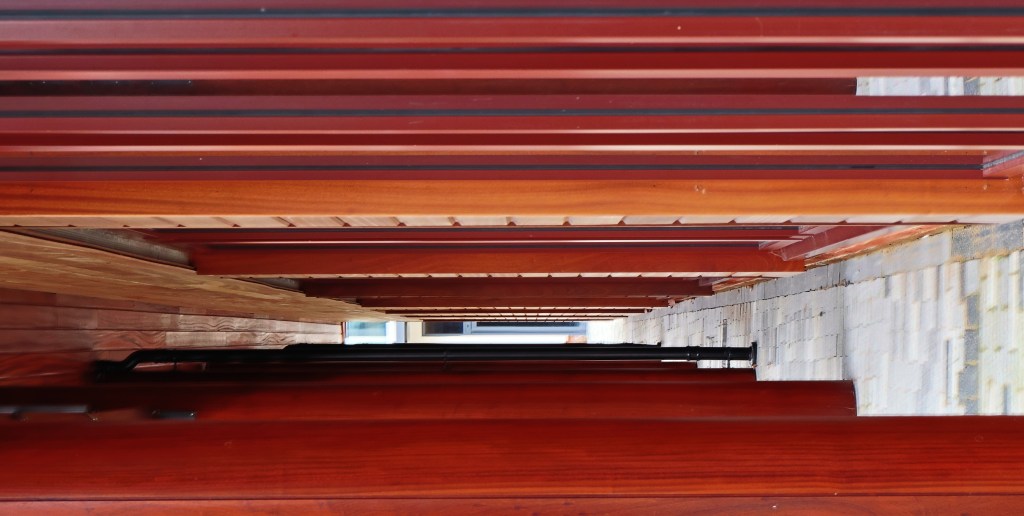
#adventapertures2025: day 18

Albert Szent-Gyorgyi, who knew a thing about maps,

by which life moves somewhere or other

used to tell this story from the war,

through which history moves somewhere or other.

‘The young lieutenant of a small Hungarian detachment in the Alps

sent out a reconnaissance unit into the icy wastes.

At once

it began to snow, it snowed for two days and the unit

did not return. The lieutenant suffered: he had sent

his own men to their deaths.

On the third day, however, the unit returned.

Where had they been? How did they find their way back?

Yes, they said, we considered ourselves 

lost and waited for the end. Then one of us

found a map in his pocket. That reassured us.

We pitched camp, waited for the snow to stop, and then

with the map

we found our bearings.

And here we are.

The lieutenant asked to see this remarkable map

and had a good look at it. It was not a map of the Alps

but the Pyranees.’

‘Albert Sent-Gyorgi’

Miroslav Holub

The Wise-Ones have asked their question, now they have to wait for the answer.  I wonder if they were impatient at the delay?  Did they feel their quest was suddenly stalled?  Or whether their wisdom traditions had taught them the importance of dreamspace, so they were content to wait for the wonder contained in the slow unfolding of unrushed revelations?  Perhaps the opportunity to put up sore feet for a few days and be in one place was welcome relief?

In her book Rest is Resistance, Tricia Hersey asks a vital question:

What miraculous moments are you missing because you aren’t resting? (81)

Persistent, extreme fatigue is a dominant symptom of my chronic illness, so I have an ambiguous relationship to resting.  It can feel like I’ve ‘lost’ half my life to the necessity of lying down, and if I’m not careful I can resent this, feeling my life has so much ‘wasted’ space in it.  

But I know, too, that while I can spend the day lying down, seemingly doing nothing, that doesn’t necessarily mean I am resting.  Rest is a quality.  Rest is an intentional activity for it’s own sake.  I do not rest, so then I can work later.  Rest is the quietening of my body, mind and spirit so I can pay attention to what I otherwise might miss. 

I need the slow quiet in order to survive.  It is an essential part of my photographic practice – that until I rest into the moment, I cannot see what wishes to be photographed.  I rush at my peril.  

Rest is dynamic and creative in and of itself.

Howard Thurman writes about the wisdom of the pause – enforced or not – in this way:

It is good to make an end of movement, to come to a point of rest, a place of pause. There is some strange magic in activity, in keeping at it, in continuing to be involved in many things that excite the mind and keep the hours swiftly passing. But it is a deadly magic; one is not wise to trust it with too much confidence. The moment of pause, the point of rest, has its own magic.

Be still,

for that is where life removes its veil, 

offering a tender grace 

that will ease you away 

from the cold chains of doing.

Be still, for only in shedding 

your dead skin of busyness 

can you find what it is to be free – 

which is un-evaluated time, 

which is gratitude

for the soft arms of existence,

that despite squeezing too tight now and then 

will nonetheless hold you

until the time comes to let you go, 

allowing you to dwell in that greater stillness – 

the loving silence of the unknown.

‘Be Still’

Gideon Heugh, Rumours of Light (88)

finding my bearings (iPhone images)

#adventapertures2025: day 17

To reach the place just ahead of you, what do you do?

            The shortest way between two points- that straight line,

the most straight of greatest renown. You put one foot in 

front of the other and carry on, repeating yourself. Until you 

reach the point ahead, assuming initial motion and no resistance.

            You walk the straight line and you journey it.

            No. Don’t.

            To reach the place just ahead of you, set out backwards

rising slowly and describe a circle complete but for the 

smallest measure between the place you left and the point 

you reach just ahead of it. And while you wheel right round towards yourself, measure a slow spiral if you like. That 

way you’ll see everything about on the slow journey between 

two juxtaposed points. That way it is rich, most rich.

            Think about it.

            Topology of the word. Speech’s own algebra.

            Think on it. 

‘24’

Stephen Watts

(Found in Ten Poems about Walking, selected by Sasha Dugdale)

There are different charts and guides available to me as I travel across the interior desert of this Advent.  The movement of moon and stars is one.  Matt Gaw in his book Under the Stars describes the various ways in which a navigator might find Polaris, the North or Pole star:

While the Plough is the easiest way to find Polaris – the North Star – the pointers forever tethered to it during the asterism’s anticlockwise spin, there are other ways.  The Northern Cross at the heart of Cygnus also points to the Lode Star.  Tristian Gooley, in his book The Walker’s Guide to Outdoor Clues and Signs, suggests thinking of the cross as a crucifix, with Jesus’ right hand pointing to the Pole Star.  Auriga, the Charioteer (which to my eyes looks more like a wonky barn), also can help find the Polaris.  By following the lean of its collapsing, obtuse side, you can find the star that sits directly above the earth’s axis.

Even when the North Star is obscured, it’s still possible to work out direction, although it can take more time.  While the points at which the moon, the planets and the sun rise change over days, weeks and months, the place on the horizon where stars rise remain constant.  Of course, the stars move (or appear to with the Earth’s spin) and the time they rise changes but their path, their trajectory, is always the same. (176-7)

Another type of map available me, part of which might also have been available to the Wise-Ones, is the Old Testament: that container for multiple books of scripture containing stories, poems, prophecies, laments. These books would have provided myriad sources of knowledge of God for those at the court of Herod the Great in Jerusalem, on whom the Wise-Ones called.  The Wise-Ones asked:

Where is the child who has been born King of the Jews?

In response Herod called together ‘all the chief priests and scribes of the people’, and he in turn asked them ‘where the Messiah, the Christ, was to be born’ (Matthew 2.4)

I can imagine the scattered and frantic discussions and disputes that took place throughout Jerusalem in response to Herod’s question.  He had asked the specialists, those Hebrew scribes and theologians who knew the scriptures intimately and who daily commentated on the Torah, the law of God, as it was to be lived out by the Jewish people.  If I had to depend on my knowledge of Scripture to answer a question of life and death, could I do it?

I doubt it.  And this is why I need the prayers of the saints who have preceded me, for their faith gives me courage and inspiration – another type of chart or map.  A couple of years ago, my parents and some of our friends walked the Cuckmere Pilgrim Path across the South Downs in East Sussex which circles through a chain of seven ancient churches.  In each church there is a pilgrim prayer.  At Wilmington this reads as follows:

Did not our hearts burn within us while He talked with us on the road, 

and while He opened the Scriptures to us? (Luke 24.32)

For each step that we might take,

Be our guide, O Lord of Life.

For each load that we might bear,

Be our strength, O Lord of Life.

For each mountain we might face,

Be our power, O Lord of Life.

For each river that might impede,

Be our safety, O Lord of Life.

For each place where we might rest

Be our peace, O Lord of Life.

For each sunrise and sunset,

Be our joy, O Lord of Life.

May God the Father who created you, guide your footsteps,

May God the Son who redeemed you, share your journey,

May God the Holy Spirit who sanctifies you, lead you on life’s pilgrimage,

and the blessing of God, Father, Son and Holy Spirit

be with you wherever you may go.

Amen.

Such prayers for guidance, strength, power, safety, peace, joy and blessing are not just metaphorically necessary for my Advent journey and beyond, but are critical not least because they teach me I do not walk alone.  I walk with God, even on my journey into the heart of that very God.  I walk with the prayers of those who pray for me.  I walk with countless unseen saints and angels.  The map of their faith is such a comfort and a wonder.

Wonder is what the angels’ eyes hold, wonder:

The eyes of faith, too, unbelieving in the strangeness.

Looking on him who makes all being gift,

Whose overflowing holds, sustains,

Who sets what is in shape,

Here in the cradle, swaddled, homeless,

And here adored by the bright eyes of angels,

The great Lord recognised.

Sinai ablaze, the black pall rising,

Through it the horn’s pitch, high, intolerable,

And I, I step across the mortal frontier

Into the feast safe in my Christ from slaughter.

Beyond that boundary, all loss is mended,

The wilderness is filled, for he,

Broker between the litigants, stands in the breach,

Offers himself for peace.

Between the butchered thieves, the mercy seat, the healing,

The place for him to test death’s costs,

Who powers his very killers’ arms,

Drives in the nails that hold him, while he pays

The debt of brands torn from the bonfire,

Due to his Father’s law, the flames of justice

Bright for forgiveness now, administering

Liberty’s contract.

Soul, look. This is the place where all kings’ monarch

rested a corpse, the maker of our rest, and in

His stillness all things that always move,

Within his buried silence.

Song for the lost, and life; wonder

For angels’s straining eyes, God’s flesh.

They praise together, they adore,

‘To him’, they shout, ‘only to him’.

And I, while there is breath left to me,

Say, Thanksgiving, with a hundred thousand words,

Thanksgiving: that there is a God to worship,

There is an everlasting matter for my singing;

Who with the worst of us, in what

he shares with me, cried under tempting,

A child and powerless, the boundless

Living true God.

Flesh rots: instead, aflame, along with heaven’s singers,

I shall pierce through the veil, into the land

Of infinite astonishment, the land

Of what was done at Calvary;

I shall look on what never can be seen, and still

Shall live, look on the one who died and who still lives

And shall; look in eternal jointure and communion,

Not to be parted.

I shall lift up the name that God

Sets out to be a mercy seat, a healing, and the veils,

And the imaginings and shrouds have gone, because

My soul stands now, his finished likeness,

Admitted now to share his secret, that his blood and hurt

Showed once, now I shall kiss the Son

And never turn away again. And never

Turn away.

‘Hymn for the Mercy Seat’

Ann Griffiths 

(as translated from the Welsh by Rowan Williams)

a well-worn path. (iPhone image)
#adventapertures2025: day 16

Be patient toward all that is unsolved in your heart and try to love the questions themselves, like locked rooms and like books that are now written in a very foreign tongue. Do not now seek the answers, which cannot be given you because you would not be able to live them. And the point is, to live everything. Live the questions now. Perhaps you will then gradually, without noticing it, live along some distant day into the answer.

Rainer Maria Rilke, Letters to a Young Poet

The above passage by poet Rainer Maria Rilke is often quoted by those interested in contemplative spirituality.  ‘Living the questions’ is a difficult art, for it requires me to be open: to be open to how I phrase my question, to be open and alive to the nuances and assumptions it might contain within it, to be open and alive and expectant about answers (yes, more than one!) coming from a range of unlikely sources.  Moreover, it requires me to be patient, to watch and wait, to be on God’s time not my own.  

As they neared Jerusalem, the Wise-Ones formed their question: Where is the child who has been born King of the Jews?  And they proposed to ask this question at the court of a Jewish King, albeit one installed by Imperial Rome as a way of minimising local disruption from the Jews in Judah.  Where might answers come from?

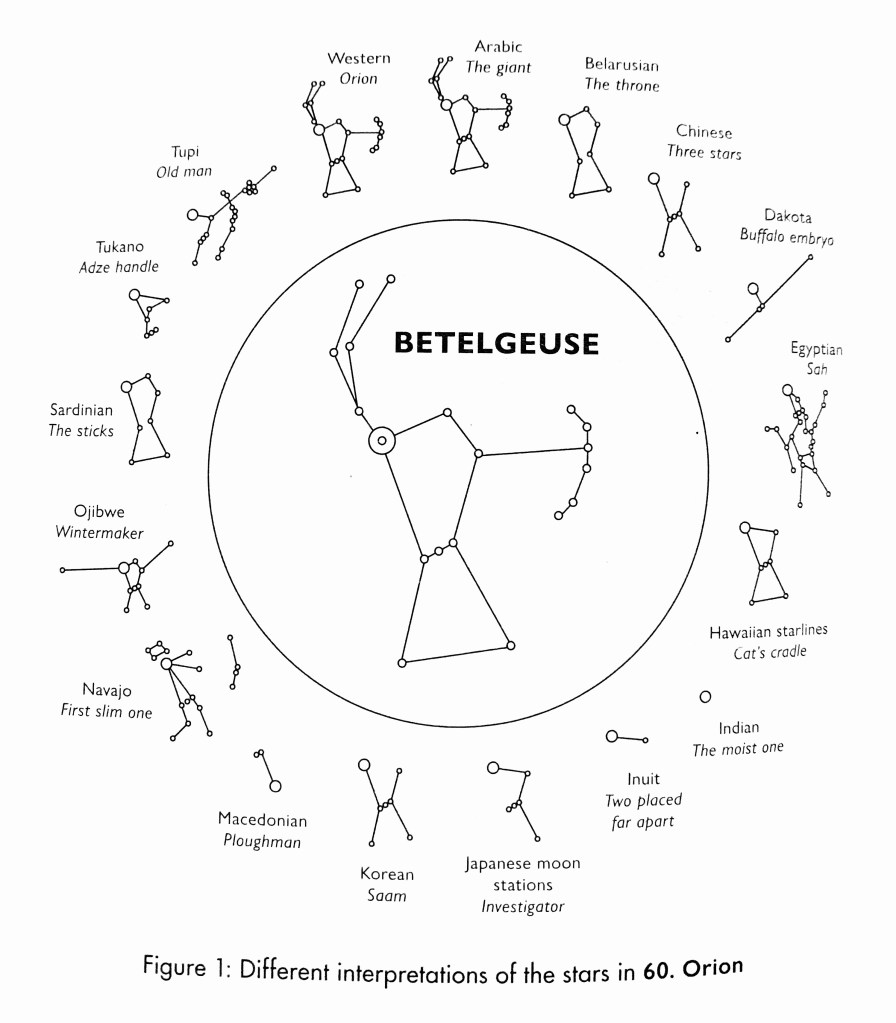
On day 8 I quoted astronomer Dr Maggie Aderin-Pocock whose book The Art of Stargazing describes how to name a star, and explains that ‘whereas (in the Western tradition) the planets of the Solar System are named after gods of classical mythology, we tend to know stars by the Arabic names given to them by medieval Islamic astronomers’ (22).  However, she also includes a fascinating diagram of the names different cultures have for the star which we now know as Orion or Betelgeuse (2). 

I find it endlessly fascinating to note the contradictions, but also the similarities, in cultural understandings of the stars which spread back centuries.  But, in the spirit of ‘living the questions’, asking which language or sign system might provide a gift for me which I need to be willing to receive requires more than intellectual curiosity.  

The Wise-Ones, who were most likely ancient Islamic astronomers, began their journey with their own symbolic understanding of the advent of a star.  Somewhere, somehow, they connected this star to the ChristStar, the star which heralded the arrival of a foreign Messiah for the people of another race and religion.  Within this broad, blunt fact how many questions must have teemed!  And how many possible, nuanced answers might be given to them, if they were prepared to open and receive.

I’ve been wondering about angels, recently;

how are they coping, with the influx?

There have been plagues like this in the past,

did they dust off the manual?

Pull out the pages on the Black Death,

and call up the waiting?

Do the angels do night shifts?

Is it ever night, in Heaven?

Do they hold hands with the weary?

Peel off masks, and gowns, and glasses,

and welcome them in?

Do the angels cry for them?

For the joy they’re about to experience,

and the loss they’ve had to endure?

Can angels cry?

And do you think God gives them overtime?

Pays them a bonus of celestial light,

or promises an hours rest from the endless singing?

Do you think they are any angels left, on Earth?

Or have they all returned home,

to join the welcoming committee?

‘Angels in a Time of Crisis’

Jay Hulme, The Backwater Sermons (18)

can angels cry? (Canon R10. f6.3. 1/15. ISO 100.)

#adventapertures2025: Sunday 3

‘It was said of Rabbi Simcha Bunim that he carried two slips of paper, one in each pocket. On one he wrote: Bishvili nivra ha’olam – “For my sake the world was created.” On the other he wrote: V’anokhi afar v’aefer – “I am but dust and ashes.” 

He would take out each slip of paper as necessary, as a reminder to himself.’

Toba Spitzer

(Found in Oliver Burkeman, Meditations for Mortals (153))

At some point, either before the journey began or along their travels, the Wise-Ones decided that the new star they had watched, recorded and observed was the ChristStar: the star of the Messiah, the long-expected, prophetically-predicted, new King of the Jews.

Somewhere along their travels, or perhaps it was their original destination, the Wise-Ones decided that the new King of the Jews would most probably be born in Jerusalem, the Jewish ‘capital’ under the Roman occupation of Judah.  Or at least, they made the assumption that even if the new King wasn’t born there, someone there would know more about the scriptures, prophecies and folk-stories of their own culture than the Wise-Ones did. Someone else would be able to enlighten them, to supply them with the answers they sought.

Whilst they followed the ChristStar across trade-routes, sea- or river-ways, road-networks or landscape features, the Wise-Ones came up with a narrative to explain their journey.  They would go to Jerusalem, head straight to the heart of the royal household, and there they would ask one basic question: 

Where is the child who has been born King of the Jews?  For we observed his star at its rising, and have come to pay him homage. (Matthew 2.2 NRSV)

With the benefit of hindsight I can see the pitfalls in this plan, the assumptions that even the Wise-Ones made.  They were focussed on receiving one single answer: Where?  Such single-mindedness gives me blinkers, and I can treat people as mere receptacles of the knowledge I seek from them, rather than seeing the whole person in front of me and  engaging in genuine dialogue.  In her DayBook, the sculptor Anne Truitt put it like this:

Unless we are very, very careful, we doom each other by holding onto images of one another based on preconceptions that are in turn based on indifference to what is other than our-selves. This indifference can be, in its extreme, a form of murder and seems to me a rather common phenomenon. We claim autonomy for ourselves and forget that in so doing we can fall into the tyranny of defining other people as we would like them to be. By focusing on what we choose to acknowledge in them, we impose an insidious control on them. I notice that I have to pay careful attention in order to listen to others with an openness that allows them to be as they are, or as they think themselves to be. The shutters of my mind habitually flip open and click shut, and these little snaps form into patterns I arrange for myself. The opposite of this inattention is love, is the honoring of others in a way that grants them the grace of their own autonomy and allows mutual discovery. (41)

By narrowing my focus, by excluding how information might be received in ways other than the most obvious, not only do I fail to receive all the information I might need – the wider context, the alternative explanations – but I ingrain a restrictive habit of seeing both myself and the one I am with.  The control I impose on another by my inattention is an effective way of killing the possible life between us.  If I do not engage what is other to me with love, then I am made poorer.  If I do this habitually then, in John O’Donohue’s words, I make ‘a strong invisible prison’ for myself:

We confine our mystery within the prison of routine and repetition… Habit is a strong invisible prison. Habits are styles of feeling, perception or action that have now become second nature to us. A habit is a sure cell of predictability; it can close you off from the unknown, the new and the unexpected. You were sent to the earth to become a receiver of the unknown. From ancient times these gifts were prepared for you; now they come towards you across eternal distances. Their destination is the altar of your heart. When you allow your life to move primarily along the tracks of habit, the creative side of your life diminishes. … constant changing about … keep[s] alive [our] sense of being pilgrims here on earth. The true pilgrim is always at a new threshold. (Eternal Echoes, (176,178))

Even as my Wise-Ones were on the adventure of their lives, their assumptions about what they needed to know for their journey endangered the very gifts it could bring them.

“The stone that the builders rejected has become the cornerstone.”

Nebuchadnezzar stared while the prophet blazed.

A stone not cut, stormed Daniel, by any human hand,

However self-righteous or self-deluded. Understand:

It is the Lord has quarried here. The king’s eyes glazed,

Because all he knew was earthly power: kings who razed

Entire cities, dogs, women, babies, mules, the very land,

Kings whose subjects, high & low, did their each command.

A stone not quarried by any hand but God’s. Amazed,

The king fell back before the prophet’s words. A stone

That would smash each self-important, self-made idol,

Whether built of gold or steel or any other thing their throne

Was made of. Yes, whatever insane, grand mal, suicidal

Impulse kings could conjure up. A stone shaped by God alone.

Womb-warm, lamb-gentle, world-wielding, tidal.

‘The Stone Not Cut by Hand’

Paul Mariani

unnoticed direction. (iPhone image)

#adventapertures2025: day 14

…darkness reaches out to offer whatever helping hand it can, calling us to trust it, saying, “Sometimes only the darkness will do.”  We owe it to the darkness to reach out and grab that hand, to respect what it has to offer, to join it to the hand of light.

Catherine Bird, The Divine Heart of Darkness (119)

How did the Wise-Ones’ needs change as they journeyed through the year?  What different ways of seeing, perspectives, would the seasonal changes make?  For they were not travelling through an English landscape where each season is distinct in its effects and impact, and each part of the wheel of the year holds its invitations and its challenges.  

Coming from the East of Palestine would have meant travelling through the Persian Empire (modern day Turkmenistan, Afghanistan, Iran, Iraq, Jordan, Turkey, Syria, Lebanon) where two main seasons would have dominated.  A hot dry ‘summer’, and a short wet season, with snow over high ground.  Temperatures might have varied from in excess of 45 degrees celsius in peak ‘summer’ to minus 4 degrees celsius on a ‘winter’ night.  When they were at home, no doubt the Wise-Ones had the means of making minute observations of the weather as it affected the night sky, but whilst travelling?  I am just adding up the challenges, and continue to be awed at the capacity for anyone to set out on a journey under such conditions, when the end result was by no means assured, and neither faith or knowledge could be guaranteed to be satisfied.

Perhaps one way the Wise-Ones understood their quest was through the eyes of Kairos time, rather than Chronos time.  Rather than counting out the days and hours chronologically in sequence, perhaps they understood the biblical sense of Kairos time as being God’s divinely appointed moment.  Kairos is about registering the opportune moment for action, which I might only realise if I pay acute attention, and there is no fixed length of that moment.  It might indeed be a critical season.  Jenny Odell, in her book Saving Time puts it like this:

As I observe at the outset of this book, chronos is homogenous while kairos is more heterogeneous, suggesting a critical moment for action. In Astra Taylor’s “Out of Time: Listening to the Climate Clock,” an essay that fundamentally influenced my entire line of questioning in this book, she notes that kairos in modern Greek now means “weather” and goes on to describe its usefulness in ecological terms: “Perhaps the opportune time to intervene is fleeting, like a passing thunderstorm or the peak of spring, and we risk a mismatch by striking too late.” It occurs to me, reading this, that the phrase isn’t “seize time.” It’s “seize the time.”

Compared to chronos, kairos sounds like the domain of those wayfarers who knew that time is inseparable from space and that every place-moment demands close attention, lest you miss your opportunity. It’s not that you can’t plan, but that the time in the plan doesn’t appear flat, dead, inert. Instead, in the “meantime,” you wait with your ear to the ground for patterns of vibration that will never repeat themselves. Faced with flatness, you look for an opening. When it comes, you take it, and you don’t look back. (272)

The Wise-Ones had no fixed plan as they travelled, for their moment was ever-changing and simultaneously fixed by the movement of the ChristStar.  They knew how to pay attention to the signs of the seasons of Kairos.  In the dark and in the frozen silences they knew how to notice.

Snow, deep snow, and bitter cold. Under the sickly, flint-coloured sky everything lies still, snow-still. Millions of unique hexagons are lost in a single blanket of white. No wind, no sound, no movement; just the squeak of fresh snow underfoot. The frozen silence is as hard and sharp as obsidian. It almost hurts. A couple of sunspots drift on the horizon. A magpie adorns a field gate like a high-contrast ornament; life imitating the art of Monet’s painting. Woodpigeons act as snowploughs, pushing their beaks into the powdery mass flipping it to either side with alternate flicks of the head, enabling them to feed on the cold grass below. A lament of lapwings billows from a field, rippling through the air like a sheet of silk caught in a breeze. The north-east wind has brought a blizzard of winter thrushes and finches to the fields – redwings with gaudy russet flanks and stylish white supercilia; fieldfares with colour-coordinated heads and tails, and bramblings sporting orange breasts and ermine rumps – chic fashion from Scandinavian sophisticates. A male bullfinch kindles from the top of a hawthorn, flaring crimson as it rises in the wan light, and undulates away, white rump blinking; a rare bird out here on the end of the peninsula. A redshank’s call rings in the air, the only liquid in this frozen landscape.

Evening is in mid-afternoon. A barn owl unfurls across the darkening fields bathed in its own aura, that inimitable inner glow. From deep within its heart-shaped face, it views the snowy scenery with ebony eyes that absorb the last of the day’s light but impart nothing in return. The finery of its plumage resembles a priest’s Easter vestments: white and gold with lilac-grey spangles. It strokes the air with muffled wings as if respecting the sanctity of the surrounding silence, and drifts gently, disappearing into the soft folds of dusk’s shadows, leaving a diffuse luminescent trail through the mind. As the sun passes below the hanging cloud it catches a passing flock of starlings, polishing them deep burnished red like a fistful of garnets flung in the sky. Ever lower, it ignites the crests of the mud in flaring orange separated by the black of the furrows that converge with perspective towards the distant sea like a grill of lava fissures, then dips below more cloud, hugging the horizon and the shadows return like the crust forming on the surface of cooling magma. Tonight it will be bitterly cold; many creatures will not greet the morning.

Phillip Edward, At The Very End of The Road (71-2)

creature out of time. (Canon R10. f11. 1/800. ISO 6400)

#adventapertures2025: day 13

Last thing each night, go out for the moon.

Pull on old coat, shut garden gate.

Roll up old sleeves. Swing arms. Poor soul.

Think moonset. Moonrise. All running to schedule.

World black and white, Walk up the lane.

Last thing each night. Look up for the moon.

No sign but rain. Almost back home.

One more last quick. Glance up for the moon.

Eyes stripped to the darkness. Can’t help but notice 

Little desklamp glow. As from upstairs window.

Shoulder of a woman. There, that’s her.

Very old poor soul, maybe all but gone.

Last thing each night, flick on flick off.

Flick on flick off. Little hand torch halo.

There that’s her. Last thing each night,

Letting only the light of a white sleeve show.

Sometimes the moon is more an upstairs window, 

Curtains not quite drawn but lit within and lived in.

And sometimes the moon is less and 

Sometimes she moves behind and sometimes she’s gone.

Sometimes it’s the moon. Sometimes it’s the rain.

‘Dream Secretary’ 

Alice Oswald, A Sleepwalk on the Severn (40)

‘Last thing each night, go out for the moon’ – while I may not go out, but I certainly look out for Her (and yes, for me, She is Sister Moon, as for Saint Francis and Dom Helder Camara before me).  I take note of where the Moon rises, where She sets, which phase of the cycle we are in.  I don’t ascribe any regular fluctuation to my energy levels to Her tug, since my illness brings its own scrambler for that kind of helpful information.  But ever since I had my hysterectomy fifteen years ago, I have wondered what elemental connection might I have lost in my blood’s tides.  I have yet to try lunar gardening, but it is on my wish-list (again, if my gardening energy would ever settle into a regular, conveniently ordered pattern – I am discovering it is hard enough to be even a seasonal gardener!)

Yet if I were an ancient Wise-One making my way across miles of desert and wilderness, wouldn’t I welcome Her company?  Although, it is equally possible I might be distracted by her, unable to see the ChristStar’s shifts when Her light was full.  If I was travelling by sea or river, ‘catching the tide’ might be all important, and seeing navigational stars equally so.  And I am sure their scientific observations would allow them to calculate the height of the tide, whether it was a Spring or Neap tide, based on the lunarsolar moment on their calendar. Just as I don’t know the cultural identity or genders of my Wise-Ones, so too I don’t know how long it might have taken them to get from home to their first destination of Jerusalem.  Walking 2 miles an hour over difficult terrain, day after day, possibly year after year, who knows?

And of course scientists know now that there are such things as ‘earth tides’, caused by the same gravitational forces of the combined work of the Sun and Moon.  Land mass shifts, causing it to rise or fall up to a foot.  We literally live on an unsteady world.  How would the Wise-Ones have understood this?  Might they have felt the earth tremble and learnt the Fear of the Israelite Yahweh that way?

Ever since reading Barbara Brown Taylor’s wonderful book Walking in the Dark, I have been fascinated by the idea that there may be such a part of the Perreniel tradition which could be interpreted as a kind of lunar spirituality.  Not the worship of the Moon as goddess, but that Her fluctuations and ever-changing, entangled nature might contain important wisdom and illustrate potentially helpful ways forward along my faith path.  I hope to be ready to write some blog pieces about this next year.  In the meantime, I consider it perfectly possible that my Wise-Ones had studied multi-cultural myths, legends, parables and stories to refine their understanding of the sky at night.  If they were able to spot the ChristStar, they could not have ignored the Moon.

Down below, the water had begun to rush over the rocks. Though I was standing still, I felt I was rushing, too, parts of me dying and other parts coming to life. There were annual growth rings on the clam shells; they reminded me of the lines on my forehead that appeared during the pandemic. Apparently, it was a time when many people aged faster, a collective compression of our biological clocks. As the water rose, I knew I could not stand there and watch the sea star forever, but I did for as long as 1 could. What I felt in that meantime was not exactly joy, but neither was it despair. It was something tidal, an oscillation back and forth, impossible to pin down and yet possibly legible to those around me: to the ducks, who would migrate again; to the trees, which would turn green again; to the mussels, who would be submerged again; to the water, which would flow back out again. Nor did my body misunderstand. In the center of me a muscle was beating, a series of creation events ongoing for now that I hadn’t started and wouldn’t stop. Under the rush of the water, I felt my heartbeats as words. They were saying what they always had: Again. Again. Again.

Jenny Odell, Saving Time (278)

Look up/Glance up (Canon R10. f10. 1/125. ISO 200)

#adventapertures2025: day 12

There exists only the present instant… a Now which always and without end is itself new. There is no yesterday nor any tomorrow, but only Now, as it was a thousand years ago and as it will be a thousand years hence. 

Meister Eckhart

Imagine if your culture had such an understanding of Deep Time, the eternal present, the Now, that they used metaphors and language that were untranslatable for someone with a Western perspective.  Like for the Amondawa Tribe, an indigenous Amazonian group, it wasn’t that they had no understanding of the abstract concept of time, or were without ways of telling the time, it was just that they couldn’t explain it in linear terms.

Kevin K. Birth calls such Western (im)perceptions ‘Time-Blindness’.  Tyson Yunkaporta, as an academic, arts critic, and member of the Apalech Clan in Queensland, Australia, is able to straddle several cultural worldviews. In his book Sand Talk: How Indigenous Thinking Can Save the World, he puts it this way:

Explaining Aboriginal notions of time is an exercise in futility as you can only describe it as “nonlinear” in English, which immediately slams a big line right across your synapses. You don’t register the “non” —only the “linear”: that is the way you process that word, the shape it takes in your mind. Worst of all, it’s only describing the concept by saying what it is not, rather than what it is. We don’t have a word for nonlinear in our languages because nobody would consider traveling, thinking, or talking in a straight line in the first place. The winding path is just how a path is, and therefore it needs no name.

Jenny Odell, in her book Saving Time, comments that the challenge of trying to conceive of time differently is urgent, ‘a matter of political and ecological import’:

Conceptions of time are deeply related to how and where we see agency, including within ourselves. They matter especially now, when the world calls out not just for action, but also a less human-centric model of who and what is owed respect and justice. 

I wonder if it is also spiritually urgent that I understand how God is the ever-present Now who defies all understanding of time?  To celebrate God’s action in entering time – in the earth-shattering moment of Incarnation – is to understand that before the Incarnation as well as after it, God is Timing – God is not the noun ‘Father Time’, nor is God a past tense.  God is agency, a verb, animate: God Times.

I suspect that the Wise-Ones understood something of this mythic quality of GodTime, SpaceTime, DeepTime.  And I would imagine that the route they chose to travel, arriving at what they came to understand was a pivotal moment.  The birth of the ChristKing marked a fundamental shift in the nature of that GodTime.  So I wonder if the Wise-Ones followed the equivalent of what psycho-geographers name ‘desire paths’, (paths made over and over by the passage of feet cutting a corner across the grass, say, rather than walking the other two sides on a pavement)?  Desire paths in DeepTime might look like a legend soaked highway across the desert, bringing truth-seekers and time-travellers to worship the child who continues to defy definition over two millennia later.

In Tse’gihi,

In the house made of the dawn, 

In the house made of the evening twilight, 

In the house made of the dark cloud, 

In the house made of the he-rain, 

In the house made of the dark mist, 

In the house made of the she-rain, 

In the house made of pollen, 

In the house made of grasshoppers, 

Where the dark mist curtains the doorway, 

The path to which is on the rainbow, 

Where the zigzag lightning stands high on top, 

Where the he-rain stands high on top, 

Oh, male divinity!

With your moccasins of dark cloud, come to us.

With your leggings of dark cloud, come to us.

With your shirt of dark cloud, come to us.

With your head-dress of dark cloud, come to us.

With your mind enveloped in dark cloud, come to us.

With the dark thunder above you, come to us soaring.

With the shapen cloud at your feet, come to us soaring.

With the far darkness made of the dark cloud over your head, come to us soaring.

With the far darkness made of the he-rain over your head, come to us soaring.

With the far darkness made of the dark mist over your head, come to us soaring.

With the far darkness made of the she-rain over your head, come to us soaring.

With the zigzag lightning flung out on high over your head, come to us soaring.

With the rainbow hanging high over your head, come to us soaring.

With the far darkness made of the dark cloud on the ends of your wings, come to us soaring.

With the far darkness made of the he-rain on the ends of your wings, come to us soaring.

With the far darkness made of the dark mist on the ends of your wings, come to us soaring.

With the far darkness made of the she-rain on the ends of your

wings, come to us soaring.

With the zigzag lightning flung out on high on the ends of your wings, come to us soaring.

With the rainbow hanging high on the ends of your wings, come to us soaring.

With the near darkness made of the dark cloud, of the he-rain, of the dark mist and of the she-rain, come to us.

(from Washington Matthews, The Prayer of First Dancers:

“The Night-Chant: a Navajo Ceremony, Memoirs of the American Museum of Natural History, 1902; ‘the prayer is addressed to a mythical thunder-bird, hence the reference to wings, though the bird is spoken of as a male divinity… The prayer is said at the beginning of work, on the last night of the Night Chant. The shaman speaks it, verse by verse, as it is here recorded, and one of the first dancers repeats, it, verse by verse, after him’; Tse’gihi: North of the San Juan River, in Colorado and Utah, are a number of canyons abounding in ruined cliff-dwellings. Tse’gihi is one of these canyons. It is often mentioned in the myths as the house of numerous gods who dwelt in the cliff-houses in ancient days. They are thought to still abide there unseen? The Night-Chant is a nine-day healing ceremony, ‘performed only during the frost weather, in the late autumn and winter months – at the season when the snakes are hibernating’.)

‘The Night chant: a Navajo Ceremony ‘

(Gigantic Cinema, Ed. Alice Oswald and Paul Keegan, 121-2)

desire path?

#adventapertures2025: day 11


Do you bow your head when you pray or do you look
up into that blue space?
Take your choice, prayers fly from all directions.
And don’t worry about what language you use,
God no doubt understands them all.
Even when the swans are flying north and making
such a ruckus of noise, God is surely listening
and understanding.
Rumi said,  There is no proof of the soul.
But isn’t the return of spring and how it
springs up in our hearts a pretty good hint?
Yes, I know, God’s silence never breaks, but is
that really a problem?
There are thousands of voices, after all.
And furthermore, don’t you imagine (I just suggest it)
that the swans know about as much as we do about
the whole business?
So listen to them and watch them, singing as they fly.
Take from it what you can


‘Whistling Swans’

Mary Oliver

I wonder if the Wise-Ones travelled part of their journey via known migration routes.  I think of the treks of the Syrian refugees fleeing their country to Turkey, or Palestinians fleeing to refugee camps in Egypt, or the Sundanese fleeing in multiple directions away from the dangers of guerrilla fighting, kidnap, child exploitation/slavery and enforced military service.  Who tells them where to go?  Are there physical tracks which are worn into the landscape made by those who have fled before them down the millennia?  Is the journey directed by aid agencies, or by word-of-mouth stories and urban myths that work and aid can be found in such-and-such a country or city?  What happens when those refugees face a closed border?  What routes can they travel, then?

Here in the UK the stories of the ‘small boats’, filled with illegal refugees and asylum seekers, is a political football, where government after government vow to ‘stop the boats’.  The British and French coastguards have to rescue countless crafts which try to make the Channel crossing in unseaworthy vessels, much like their Italian, Greek and Turkish counterparts have to monitor the small boats attempting to cross the Mediterranean.  I have no idea whether my Wise-Ones would have needed to cross a body of water as they followed the ChristStar, and what local guides they might need to have employed who knew the rivers and tides, the ebbs and flows in their bones.  One of my favourite traditional English Carols ‘I saw Three Ships’, which whimsically imagines the Holy Family coming into an English port on Christmas Day, is derived from older songs about the Magi arriving at land-locked Bethlehem in ships, (presumably meant to refer to camels, known as ‘the ships of the desert’ in some traditions). I can imagine the kind of starred seaways which might need to be plotted to get the Holy family safely away to England, as some myths have it.

“We think of migration as a moving away from something unpleasant, when it is just as often a moving toward something beneficial”, writes Scott Weidensaul … ‘It is also the pursuit of the sun; the Arctic tern, which nests at high northern latitudes and winters in the extreme south, enjoys a greater percentage of daylight in its life (and thus more hours in which to hunt) than any other animal on earth.’ He describes them as drawing ‘a 22,000-mile figure of eight on the Atlantic Ocean’. (From Amanda Thomson, Belonging, 108)

Reading this reminded me of a BBC Radio Four series from 2023, when the BBC partnered with a conservation team led by biologist Sacha Dench to make a radio series Flight of the Ospreys, tracking the migratory route of a pair of Ospreys from Scotland to their winter grounds in Guinea-Bissau.  Scientists know so little about how Ospreys navigate, and this was an opportunity for first hand tracking, and to see the ways in which the Ospreys tackled the huge challenges of avoiding prey, particularly over the open water stretch at the Mediterranean – including whether they flew at night and navigated by the stars as some other migrating birds are thought to do. 

A few years before, Dench had partnered with WWT to follow the epic autumn migration of the Bewick Swans, flying with the birds in a special paramotor from the Russian Artic to England on a journey of three months.  Dench observes:

From the air, a bird’s-eye-view, there are things you cannot help but see. Polluting run-off after rain, the absence of wetlands around intensive agriculture, the bubbles coming from pools in the Arctic, a sign of the permafrost thawing… Whilst I am aware of the climate and biodiversity crises as facts, to see these from above, on a setting of a finite planet, makes them very real. But whilst our impacts are clearer, they also look a bit smaller, and easier to solve.

The way one navigates, then, also might affect the way one sees.

Deep peace of the running wave to you,
Deep peace of the flowing air to you,
Deep peace of the quiet earth to you,
Deep peace of the Flock of Stars to you,
Deep peace from the Son of Peace to you,
Deep peace, deep peace!

Fiona Macleod, ‘Deep Peace’, The Dominion of Dreams: Under the Dark Star (William Sharp,1895). 

 Listen to John Rutter’s setting of this Gaelic blessing here

I saw Three Ships (iPhone image)

#adventapertures2025: day 10

I would like to thank God

for:

Cyan and Cerulean,

Arctic and Azure,

Teal and Turquoise,

for the ever varying light of the sky

and for the infinite ocean hues.

I only asked for Blue.

Tim Eddy

I’ve been thinking about how the Wise-Ones might have planned their journey.  I am learning to recognise that different maps or charts are informed by their makers, and by their usage.  Any navigational tool holds the potential to change my perspective, to open my eyes to new ways of seeing place and people.

As I researched how the Wise-Ones might navigate by the stars, I discovered that the strategic advice for runaway slaves escaping from their owners via the Underground Railway movement, was how to first locate and follow the constant North Star:

“Keep your eye on the North Star” was the advice because by keeping that star in sight, up ahead, the runaway slaves could be sure they were heading in the right direction.  Of course, this meant always moving at night.  But how to be sure they had located the correct star?  I was always taught to identify it by looking for the saucepan with a bent handle – an easier description to understand than the formal Latin name of the group of stars, Ursa Major (Big Bear).  The runaway slaves were taught to look for the constellation that looked like a drinking gourd – it was common at the time to use a hollowed-out gourd to drink water, and these were supposed to look like long-handled cups.  Those planning escape were told, “Two star’s on the cup’s edge always point to the North Star.”  There is even a traditional song, “Follow the Drinking Gourd”, which describes this and other signs used by people escaping to the North:

The riverbank makes a very good road

the dead trees show you the way

left foot, peg foot, travelling on 

follow the drinking gourd

When the sun comes back and the first quail calls

follow the drinking gourd

for the old man is waiting to carry you to freedom

if you follow the drinking gourd

(found in Catherine Bird, The Divine Heart of Darkness, 117)

I can barely imagine the fear levels of those runaway slaves muttering this song to themselves as they hid by day and travelled by night.  I know that the Underground Railway movement took inspiration from the story of the Exodus of the Hebrew People from Egypt at night.  I wonder what stories those who flee from modern slavery are told today?  Where might their guidance systems come from?  What myths encourage their spirits?  In a smartphone dependent world, what internal GPS do we have left if we are without technology?  Whose power, then, might we be at the mercy of?

My Wise-Ones came from the east into the Roman Empire, with its technologically straight roads.  I wonder if once they had made it as far as this road network they were able to use the itinerarium, the Latin lists of milestones, place names and landmark features which described the section of road you wished to travel. These were published in public places so one could copy them to take away and follow.  Such imperial codification brings with it a whole new set of assumptions and cultural norms through which to negotiate a safe path.  How many languages would the Wise-Ones have needed to have spoken, read or recognised on their journey?  I feel adrift in a foreign land just thinking about it.

My love, I’m grateful tonight

Our listing bed isn’t a raft

Precariously adrift

As we dodge the coast guard light,

And clasp hold of a girl and a boy.

I’m glad we didn’t wake

Our kids in the thin hours, to take 

Not a thing, not a favorite toy,

And didn’t hand over our cash

To one of the smuggling rackets, 

That we didn’t buy cheap life jackets 

No better than bright orange trash

And less buoyant. I’m glad that the dark 

Above us is not deeply twinned 

Beneath us, and moiled with wind, 

And we don’t scan the sky for a mark,

Any mark, that demarcates a shore

As the dinghy starts taking on water.

I’m glad that our six-year-old daughter, 

Who can’t swim, is a foot off the floor

In the bottom bunk, and our son 

With his broken arm’s high and dry, 

That the ceiling is not seeping sky, 

With our journey but hardly begun.

Empathy isn’t generous,

It’s selfish. It’s not being nice 

To say I would pay any price 

Not to be those who’d die to be us.

‘Empathy’ 

AE Stallings 

Afterlife, 124-5

signs or portents? (iPhone image)

#adventapertures2025: day 9

I have begun,

when I’m weary and can’t decide an answer to a bewildering question

to ask my dead friends for their opinion

and the answer is often immediate and clear.

Should I take the job? Move to the city? Should I try to conceive a child

in my middle age?

They stand in unison shaking their heads and smiling—whatever leads

to joy, they always answer,

to more life and less worry.  I look into the vase where Billy’s ashes were—

it’s green in there, a green vase,

and I ask Billy if I should return the difficult phone call, and he says, yes.

Billy’s already gone through the frightening door,

whatever he says I’ll do.

‘My Dead Friends’ 

Marie Howe

Maps and charts are ways of seeing.  They are ways of interpreting the world from my own viewpoint.  They can also be a sign of my own cultural and linguistic norms. For example in Saving Time, Jenny Odell cites Tyson Yunkaporta, whose book Sand Talk attempts to tease out some of the different cultural norms inherent in indigenous thinking:  

Yunkaporta complains that “it is hard to write in English when you’ve been talking to your great-grandmother on the phone, but she is also your niece, and in her language there are no separate words for time and space.” He explains that in his great-grandmother/ niece’s kinship system, there is a reset every three generations where your grandparents’ parents get classified as your children, because “the granny’s mother goes back to the center and becomes the child.” Furthermore, a question that translates in English as “What place?” actually means “What time?” According to the paradigm his great-grandmother/ niece uses, these two features are naturally intertwined: “Kinship moves in cycles, the land moves in seasonal cycles, the sky moves in stellar cycles, and time is so bound up in those things that it is not even a separate concept from space. We experience time in a very different way from people immersed in flat schedules and story-less surfaces. In our spheres of existence, time does not go in a straight line, and it is as tangible as the ground we stand on.

Odell draws my attention to that final phrase, ‘Note how different “the ground we stand on” is from abstract space. Yunkaporta’s “ground” is not a metaphor. It is referring to real ground, every bit as concrete as the Newtonian, imagined grid of space as empty, abstract, and “flat.”’ She goes on to explain how she was confronted by Yunkaporta’s complaint, 

that the word nonlinear casts linearity as the default. He mentions a man who “tried going in a straight line many thousands of years ago and was called wamba (crazy) and punished by being thrown up into the sky,” adding that “this is a very old story, one of many stories that tell us how we must travel and think in free-ranging patterns, warning us against charging ahead in crazy ways.” 

Is my Advent journey one of straight lines? No.  I approach the celebration of the birth of Christ again, but also as if it were the first time.  This year’s Advent retreat overlaps and spirals with the one before it, and the one before that.  In this way my sense of time becomes a deep one.  And it continues back (or forward) beyond my birth.  In this way, the Wise-Ones become my ancestors.  I journey across the ever-sifting sands of time as one of them, re-dreaming the world I wait for as I go.  

I am waiting for my case to come up   

and I am waiting

for a rebirth of wonder

and I am waiting for someone

to really discover America

and wail

and I am waiting   

for the discovery

of a new symbolic western frontier   

and I am waiting   

for the American Eagle

to really spread its wings

and straighten up and fly right

and I am waiting

for the Age of Anxiety

to drop dead

and I am waiting

for the war to be fought

which will make the world safe

for anarchy

and I am waiting

for the final withering away

of all governments

and I am perpetually awaiting

a rebirth of wonder

I am waiting for the Second Coming   

and I am waiting

for a religious revival

to sweep thru the state of Arizona   

and I am waiting

for the Grapes of Wrath to be stored   

and I am waiting

for them to prove

that God is really American

and I am waiting

to see God on television

piped onto church altars

if only they can find   

the right channel   

to tune in on

and I am waiting

for the Last Supper to be served again

with a strange new appetizer

and I am perpetually awaiting

a rebirth of wonder

I am waiting for my number to be called

and I am waiting

for the Salvation Army to take over

and I am waiting

for the meek to be blessed

and inherit the earth   

without taxes

and I am waiting

for forests and animals

to reclaim the earth as theirs

and I am waiting

for a way to be devised

to destroy all nationalisms

without killing anybody

and I am waiting

for linnets and planets to fall like rain

and I am waiting for lovers and weepers

to lie down together again

in a new rebirth of wonder

I am waiting for the Great Divide to be crossed   

and I am anxiously waiting

for the secret of eternal life to be discovered   

by an obscure general practitioner

and I am waiting

for the storms of life

to be over

and I am waiting

to set sail for happiness

and I am waiting

for a reconstructed Mayflower

to reach America

with its picture story and tv rights

sold in advance to the natives

and I am waiting

for the lost music to sound again

in the Lost Continent

in a new rebirth of wonder

I am waiting for the day

that maketh all things clear

and I am awaiting retribution

for what America did   

to Tom Sawyer   

and I am waiting

for Alice in Wonderland

to retransmit to me

her total dream of innocence

and I am waiting

for Childe Roland to come

to the final darkest tower

and I am waiting   

for Aphrodite

to grow live arms

at a final disarmament conference

in a new rebirth of wonder

I am waiting

to get some intimations

of immortality

by recollecting my early childhood

and I am waiting

for the green mornings to come again   

youth’s dumb green fields come back again

and I am waiting

for some strains of unpremeditated art

to shake my typewriter

and I am waiting to write

the great indelible poem

and I am waiting

for the last long careless rapture

and I am perpetually waiting

for the fleeing lovers on the Grecian Urn   

to catch each other up at last

and embrace

and I am awaiting   

perpetually and forever

a renaissance of wonder

‘I am waiting’

Lawrence Ferlinghetti

how to travel in cycles. (iPhone image)