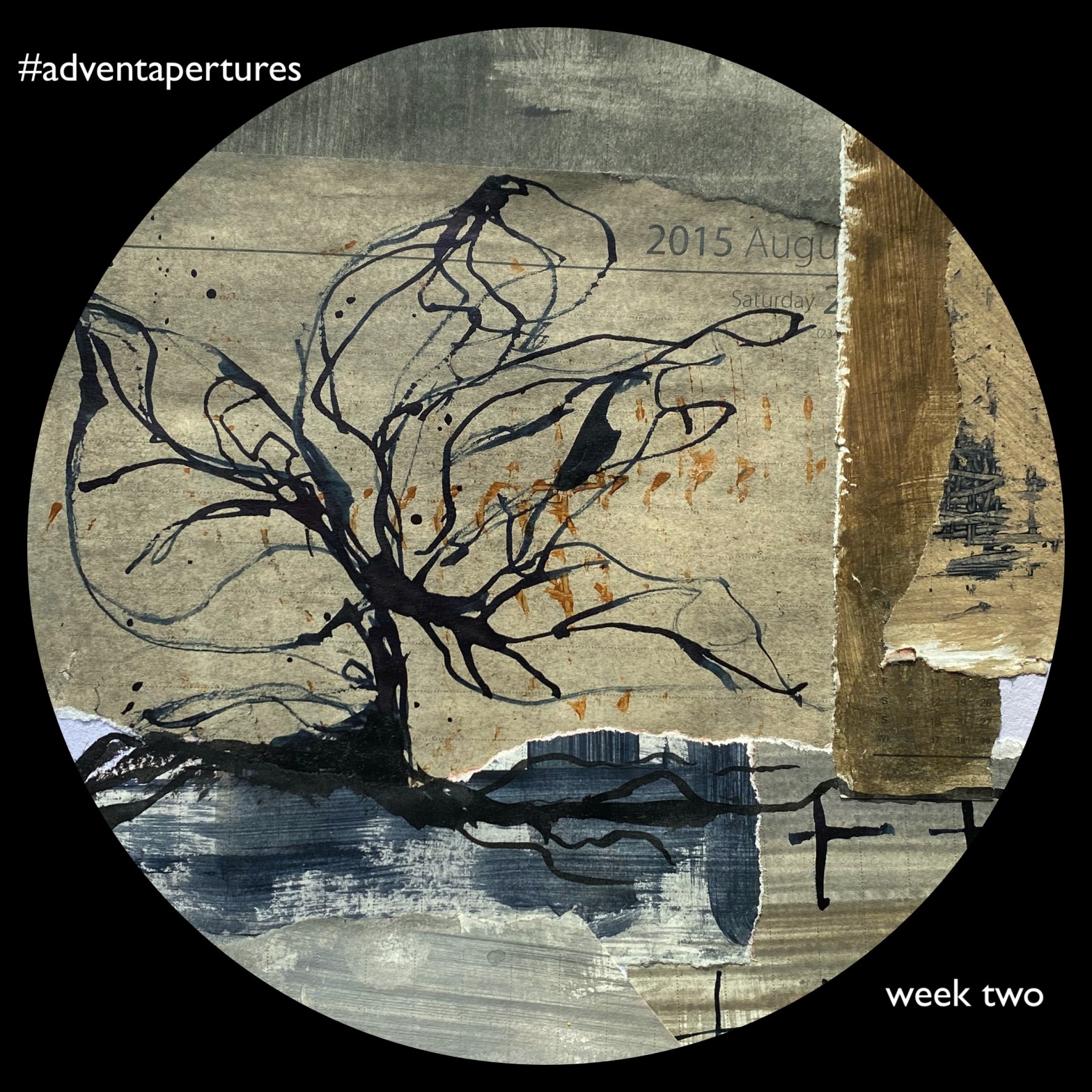
Last thing each night, go out for the moon.
Pull on old coat, shut garden gate.
Roll up old sleeves. Swing arms. Poor soul.
Think moonset. Moonrise. All running to schedule.
World black and white, Walk up the lane.
Last thing each night. Look up for the moon.
No sign but rain. Almost back home.
One more last quick. Glance up for the moon.
Eyes stripped to the darkness. Can’t help but notice
Little desklamp glow. As from upstairs window.
Shoulder of a woman. There, that’s her.
Very old poor soul, maybe all but gone.
Last thing each night, flick on flick off.
Flick on flick off. Little hand torch halo.
There that’s her. Last thing each night,
Letting only the light of a white sleeve show.
Sometimes the moon is more an upstairs window,
Curtains not quite drawn but lit within and lived in.
And sometimes the moon is less and
Sometimes she moves behind and sometimes she’s gone.
Sometimes it’s the moon. Sometimes it’s the rain.
‘Dream Secretary’
Alice Oswald, A Sleepwalk on the Severn (40)
‘Last thing each night, go out for the moon’ – while I may not go out, but I certainly look out for Her (and yes, for me, She is Sister Moon, as for Saint Francis and Dom Helder Camara before me). I take note of where the Moon rises, where She sets, which phase of the cycle we are in. I don’t ascribe any regular fluctuation to my energy levels to Her tug, since my illness brings its own scrambler for that kind of helpful information. But ever since I had my hysterectomy fifteen years ago, I have wondered what elemental connection might I have lost in my blood’s tides. I have yet to try lunar gardening, but it is on my wish-list (again, if my gardening energy would ever settle into a regular, conveniently ordered pattern – I am discovering it is hard enough to be even a seasonal gardener!)
Yet if I were an ancient Wise-One making my way across miles of desert and wilderness, wouldn’t I welcome Her company? Although, it is equally possible I might be distracted by her, unable to see the ChristStar’s shifts when Her light was full. If I was travelling by sea or river, ‘catching the tide’ might be all important, and seeing navigational stars equally so. And I am sure their scientific observations would allow them to calculate the height of the tide, whether it was a Spring or Neap tide, based on the lunarsolar moment on their calendar. Just as I don’t know the cultural identity or genders of my Wise-Ones, so too I don’t know how long it might have taken them to get from home to their first destination of Jerusalem. Walking 2 miles an hour over difficult terrain, day after day, possibly year after year, who knows?
And of course scientists know now that there are such things as ‘earth tides’, caused by the same gravitational forces of the combined work of the Sun and Moon. Land mass shifts, causing it to rise or fall up to a foot. We literally live on an unsteady world. How would the Wise-Ones have understood this? Might they have felt the earth tremble and learnt the Fear of the Israelite Yahweh that way?
Ever since reading Barbara Brown Taylor’s wonderful book Walking in the Dark, I have been fascinated by the idea that there may be such a part of the Perreniel tradition which could be interpreted as a kind of lunar spirituality. Not the worship of the Moon as goddess, but that Her fluctuations and ever-changing, entangled nature might contain important wisdom and illustrate potentially helpful ways forward along my faith path. I hope to be ready to write some blog pieces about this next year. In the meantime, I consider it perfectly possible that my Wise-Ones had studied multi-cultural myths, legends, parables and stories to refine their understanding of the sky at night. If they were able to spot the ChristStar, they could not have ignored the Moon.
Down below, the water had begun to rush over the rocks. Though I was standing still, I felt I was rushing, too, parts of me dying and other parts coming to life. There were annual growth rings on the clam shells; they reminded me of the lines on my forehead that appeared during the pandemic. Apparently, it was a time when many people aged faster, a collective compression of our biological clocks. As the water rose, I knew I could not stand there and watch the sea star forever, but I did for as long as 1 could. What I felt in that meantime was not exactly joy, but neither was it despair. It was something tidal, an oscillation back and forth, impossible to pin down and yet possibly legible to those around me: to the ducks, who would migrate again; to the trees, which would turn green again; to the mussels, who would be submerged again; to the water, which would flow back out again. Nor did my body misunderstand. In the center of me a muscle was beating, a series of creation events ongoing for now that I hadn’t started and wouldn’t stop. Under the rush of the water, I felt my heartbeats as words. They were saying what they always had: Again. Again. Again.
Jenny Odell, Saving Time (278)
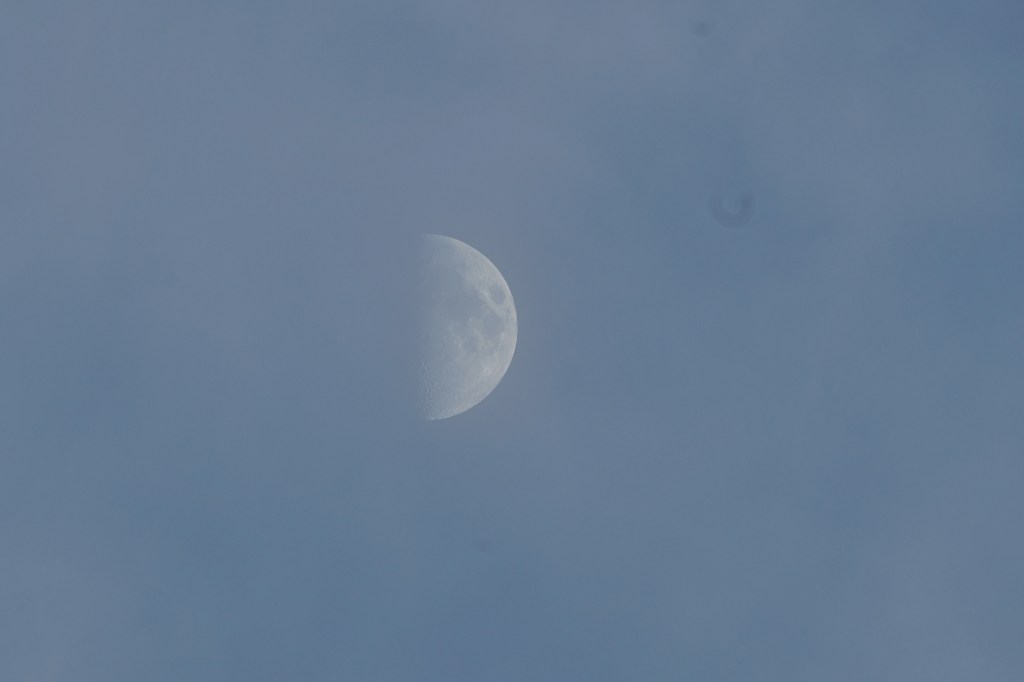
Look up/Glance up (Canon R10. f10. 1/125. ISO 200)

