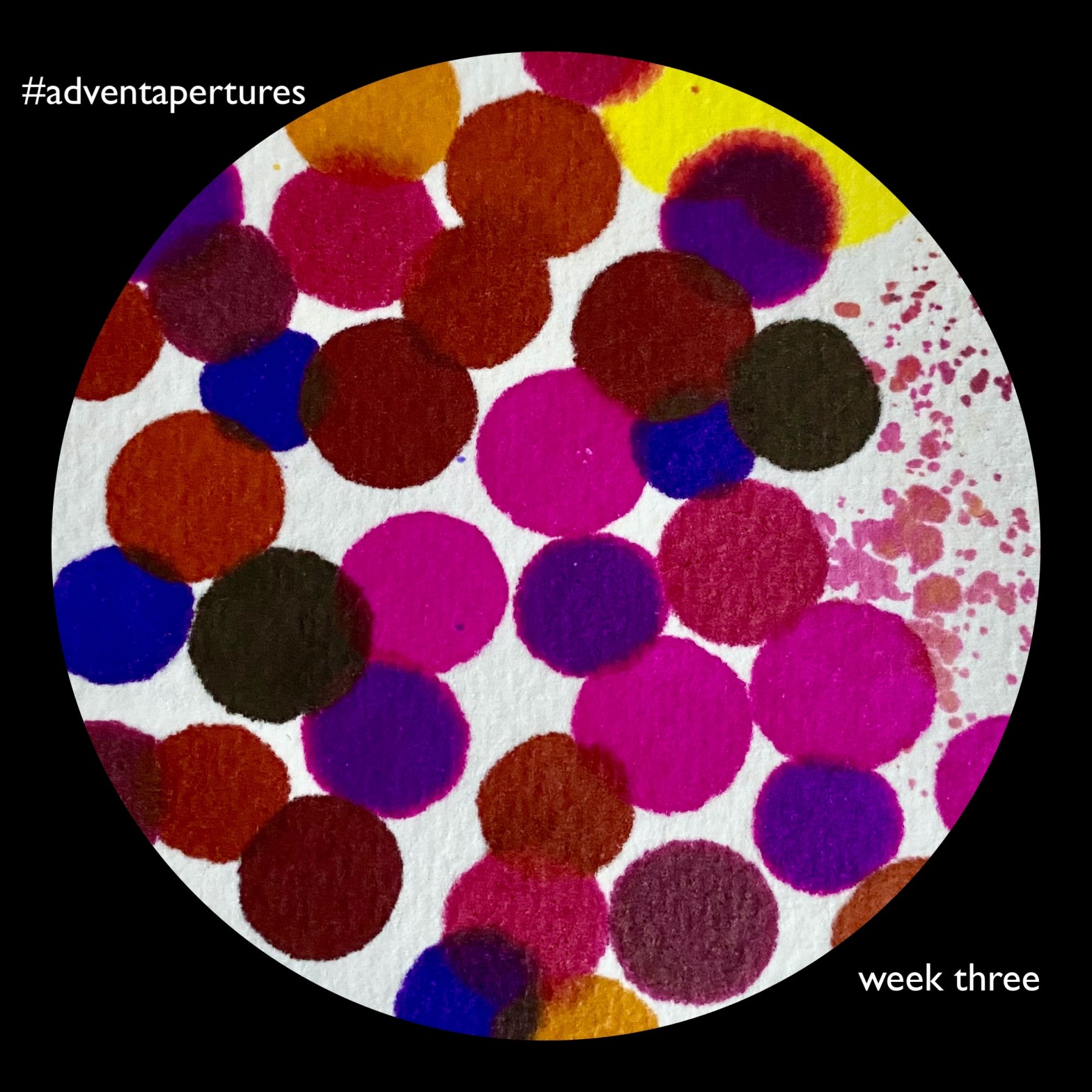
Silence has its own notation: dark
Jottings of duration, but not pitch,
A long black box, or little feathered hitch
Like a new Greek letter or diacritical mark
Silence is a function of Time, the lark
In flight but not in song. A nothing which
Keeps secrets or confesses. Pregnant, rich,
Or awkward, cold, the pause that makes us hark,
The space before or after: it’s the room
In which melody moves, the medium
Through which thought travels, it is golden, best,
Welcome relief to talk-worn tedium.
Before the word itself, it was the womb.
It has a measure. Music calls it rest.
‘Silence’
AE Stallings, Afterlife (170)
I wrote yesterday that answers sometimes come through silence, and in yesterday’s final reading, Anna Blaedel cited Rabbi Abraham Heschel, ‘that prayer begins at the edge of emptiness’. One of the silences affecting the Wise-Ones while they waited for the scriptural experts to answer their question, was the relative emptiness of the night-sky. The ChristStar had disappeared. Their single guiding light was extinguished, was absent, had gone dark.
A darkness enough to swallow a ChristStar sounds like the pre-creation type of chaos of the Genesis stories.
One of my favourite artists is the abstract painter Mark Rothko, and although I love some of the shimmering ‘bright’ coloured works, the ones I am fascinated by are the huge, dark canvases he made for the non-denominational chapel at Houston. In her book The Divine Heart of Darkness, Catherine Bird spoke to Suna Umari, a long-time servant of the chapel, who says, “They’re sort of a window to beyond . .. the bright colors sort of stop your vision at the canvas, where dark colors go beyond. And definitely you’re looking at the beyond. You’re looking at the infinite.” (98). Bird goes on to write:
Physics tells us that black is not actually a colour at all, rather it is what the eye sees when deprived of any visible light. Something appears black if it absorbs light, rather than reflecting it back so the eye can see. The more a substance absorbs light and the colour it contains, the blacker it appears. Hence the person wearing black in the sunshine becomes something of a heat magnet! Looking at it from a more artistic perspective, black can be created by merging the three primary colours, which themselves combine in varying degrees to form every other shade the eye can see. Whichever way you look at it – black as the absorber of all colour, or black as the combination of all colour – black takes on a richness and depth which belies its immediate, austere appearance. So it is possible to see within the dark paintings of Rothko not a harsh and uninviting gloominess, but rather work which incorporates and holds everything that ever was, and ever will be. In this way they become images of hope and possibility. Rothko’s exploration and treatment of dark colours offers a delightful opportunity to consider their nature, to look below the surface, and release ourselves from the shackles of preconception. (108)
I wonder if while they were waiting in Jerusalem, wondering if their journey was over or whether it would continue, the Wise-Ones were able to come to this kind of appreciation of the what-looks-like black emptiness? Their familiarity with the night-sky might have given them hope that the absence of the ChristStar was either a scientific ‘blip’, a temporary anomaly. Or, perhaps they had already understood, and seen from their observatories before their journey began, that the apparently empty-dark is normally teeming with the kinds of darklight that were familiar to Rothko’s spiritual sensibilities and artistic expressions centuries later.
Can I let my darkness and silence teem with the divine as i approach the shortest day and the longest night?
In a dark mood I wandered at night-time,
Most people were in bed, some lights still shone.
In the far distance; trains made happy sounds,
A going off with jubilation. I
Tried to think of them,
In childhood distant trains
Were a good lullaby.
But now I was grown-up and wandered looking … for what…?
I did not know and yet I felt my spirit
Stirring with some glad power.
Between a dream and a nightmare I had come
To this strange city not on any map
That I’d been shown at school
And yet I knew I had to take quiet steps
Even as I felt afraid of crossing
Almost every street. What fear was this?
Where did it come from? Why
Had it made me think
I must put on a jacket and go out?
The season was so vague, the moon was half
But not a star was there for me to look at,
Not a human-being anywhere
Could join this search whose goal I did not know.
The God whom I had always prayed to still
Existed but he seemed too far away
To give a blessing or explain why I
Had to walk upon what was perhaps
A pilgrimage though there was not a sign
In air, on ground, close to the moon, to say
I must know dark and carry it about.
Dear God, this was a doubt about a doubt.
‘Walking in the Dark’
Elizabeth Jennings
(from Praises (10))
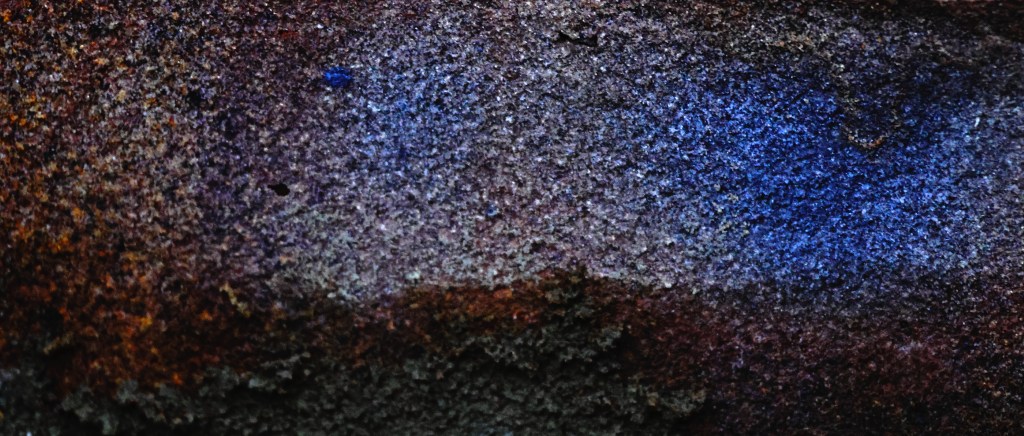
incorporating hope. (iPhone image)


This is a great series, Katie. Beautiful image. L D
l d
LikeLike