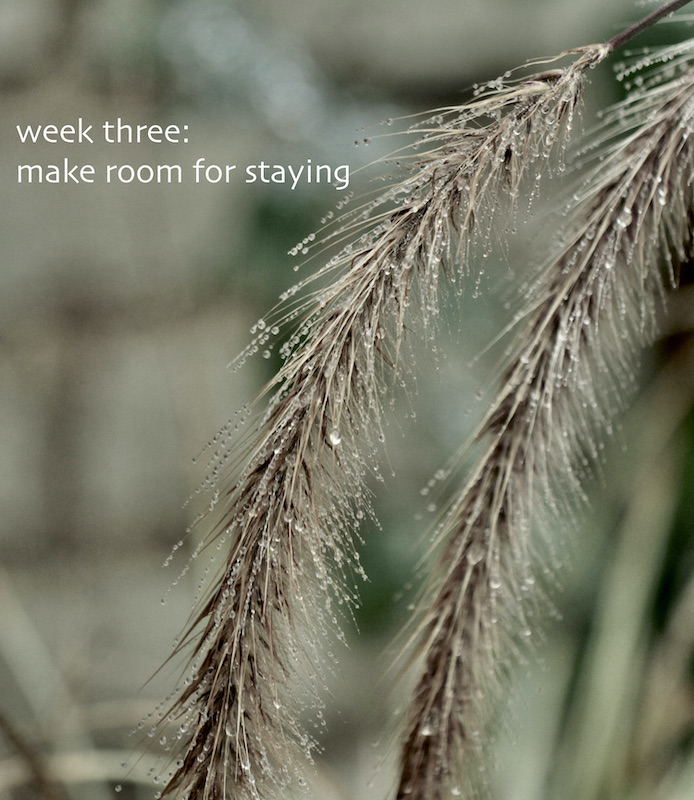
Earth teach me stillness
as the grasses are stilled with light.
Earth teach me suffering
as old stones suffer with memory.
Earth teach me humility
as blossoms are humble with beginning.
Earth Teach me caring
as the mother who secures her young.
Earth teach me courage
as the tree which stands alone.
Earth teach me limitation
as the ant which crawls on the ground.
Earth teach me freedom
as the eagle which soars in the sky.
Earth teach me resignation
as the leaves which die in the fall.
Earth teach me regeneration
as the seed which rises in the spring.
Earth teach me to forget myself
as melted snow forgets its life.
Earth teach me to remember kindness
as dry fields weep in the rain.
‘Earth Teach Me’
Chief Yellow Lark
When I make room for the planet to teach me, I receive such wonder. Even the small act of looking out of the window can bring the natural world in to me in powerful ways. When I am staying with my parents, which is often at times when I am particularly unwell, my beloved Mum has a gift for ‘bringing the outside in’. It might be a Magpie feather, it might be a posy of flowers, it might be acorns or sweet chestnuts picked up on a walk. In return, I give them what I can: photographs of the sky, made from bed. That way we all learn about cloud formations and wind directions, about jet engine contrails and air pollution colours, about the wax and wane of the moon. In this way we add concern in with our wonder, and form a prayer based on our looking which extends beyond our sight, beyond the skies above the Surrey Hills.
So many highly-skilled scientists are involved in making the planet’s populations aware of the dangers of climate change and are offering technological possibilities of restricting its impact. So many deeply-thoughtful artists are working on long-term projects to demonstrate the impact of the ‘big ideas’ at a local, small-scale, even personal, level. I recently learnt of David Cass’s ‘Where Once the Waters’ project about sea-level rise, as described by the artist Samantha Clark:
“The project takes two forms. In one, Cass has been asking people from all over the world to participate by offering details of their date of birth and location. He responds by sending them a letter, typed using an old manual typewriter on re-used, often antique papers sourced from flea markets. These outline the calculation of sea level rise that has occurred at or near their birthplace, within their lifetimes, offering this information in plain, undramatic statements. They tell a global story that is vast in its implications yet personal in its impacts.
In the second, Cass has been continuing his series of small-scale seascape paintings on objects also often found in fleamarkets: old storage tins, cigar or matchboxes, cotton reels, snuff boxes, the battered flotsam and jetsam of lives long since passed. The surface charm of these works belies their serious message – that sea horizon is shifting and we, each one of us, need to pay attention. Cass links the local, the small-scale, the personal, even pocket-sized, first to the coastline nearest our birthplace and then to the world’s oceans. This is a linking of temporal and geographical scales that we need to feel. But our personal connection with global forces is not just a game of perception. It’s deeply political.
Clark is right to press my need to pay urgent attention to these shifts in climate change, which are not about somewhere distant and foreign to me, but are about what I might grow in my garden. It’s about how I might grow in my garden too. All my actions have potential geo-political significance: the waste I produce, the energy I consume, the water I use. How I brush my teeth can be a political act, whether I ignore climate scientists or not.
Yet, by grace, even how I brush my teeth can become a contemplative, more – a redemptive – act, when I take into account the materials, water and energy it takes and reduce my negative impact on the planet just a little as a consequence. Small differences add up to huge generative changes. The earth itself will teach us how – if we choose to listen to how the God-With-Us is made incarnate daily.
Drawing insight from Bonaventure’s metaphors for God, Ilia Delio writes that contemplation naturally leads to compassionate care for the earth:
While this Franciscan path of contemplation is desperately needed in our world today as we face massive suffering and vast ecological crises, we still live, in our western culture, with an emphasis on rationality, order and mind. Because our “I” is separated from the world around us, we struggle to be incarnational people and to see our world imbued with divine goodness. We fail to contemplate God’s love poured out into creation. . . .
The Franciscan path to God calls us to gaze on the crucified Christ and to see there the humble love of God so that we may, like Francis, learn to see and love the presence of God’s overflowing goodness hidden, and yet revealed, in the marvelous diversity of creation. The one who contemplates God knows the world to be charged with the grandeur of God. Contemplation leads to a solidarity with all creation whereby all sorrows are shared in a heart of compassionate love, all tears are gathered in a womb of mercy, all pain is healed by the balm of forgiveness. The contemplative sees the threads of God’s overflowing love that binds together the whole of creation in a web of infinite love. We are called to see deeply that we may love greatly. And in that great love, rejoice in the overflowing goodness of God.
Ilia Delio, Franciscan Prayer (Cincinnati, OH: St. Anthony Messenger Press, 2004), 139–140. Richard Rohr’s Daily Meditation, Thursday 6th October 2022

these tracks I make. Canon 7D. (f11. 1/25. ISO 320.)
 image into ikon
what a beautiful Franciscan poem of contemplation, hope & love.
sounds as though you are undertaking quite a lot of research to write this advent series; the poetic flow and message of being more present to the natural world and our connection with each other is beautiful.
thank you ♥️
LikeLiked by 1 person