Things – including concepts and bodies – are inexhaustible; they show up only partially. If you can see everything, then you’ve already missed a spot.
Bayo Akomolafe, These Wilds beyond our Fences (155)
To seek context is already to acknowledge you don’t have the whole story … an ecological understanding takes time. Context is what appears when you hold your attention open for long enough: the longer you hold it, the more context appears.
Jenny Odell, How to Do Nothing (155)
When I begin a journey, do I ask how, or where, does this road end? Don’t I normally have a destination in mind and a reason for travelling? If I am are rolling in the footsteps of the holy family during this Advent, then the first destination is Nazareth. Not a place where many pilgrims will be going this year, I imagine. But I wonder: in my journey into the heart of the God-Who-Is-Already-Coming in the other direction towards me, the God-Who-Has-Already-Come, and the God-Who-Will-Keep-Coming in the future, do I really know my destination?
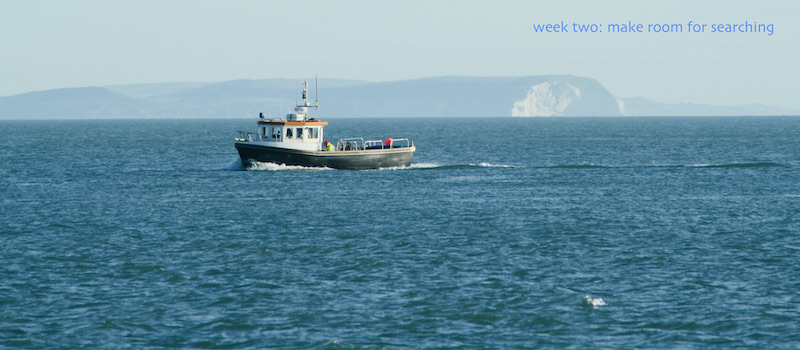
I cannot ‘know’ God in their entirety. I don’t have the whole story. I will have missed more than one spot. So I need to make room for searching, for seeing what happens along the way, for being curious about when, and how, the God-Of-Us might show up to the Us-Of-God, that is to all peoples, on all the earth.
This autumn, a friend lent me Raynor Wynn’s The Salt Path, one couple’s Odyssey along the South West Coastal Path of England. The reason for their journey is made clear at the outset: they have just been made homeless and Moth, Raynor’s husband, has received a terminal illness diagnosis (in his early 50’s), so walking from Minehead to Land’s End made as much sense as anything else, (for they had been made rudderless as well as bankrupt by a five-year-long court case which took everything from them, including their physical health). They do not know ‘what next?’ because it feels like ‘next’ is impossible. All there is, is to put one foot in front of the other, so that what is a literal act might perhaps become a metaphorical, emotional and spiritual act in its turn.
One night along the path, they stumble on a group of surfers. On hearing their story, one young man tells them they are like ‘a wave’. Not understanding surfer-speak, Raynor and Moth ask for an explanation. This is what they are told:
‘Yeah, how good a wave is depends on what nature’s doing. It starts to pick up when the wind blows on the water, way out at sea, then it’s all down to how strong that wind is, how long it blows for and how far it travels across the water – we call that the fetch. A big wind, a long fetch, a good stretch of coastline, and you’ve got it, you’re barrelling. But you, you’re blown up by a f•••ing gale, man, and your fetch is still running, you’re heading for the biggest, cleanest barrelling wave, man? Don’t you get it? You’re gonna swash in style!’
It feels like my ‘fetch’ is still running, too. My journey with chronic ill health began with a ‘gale’ of a diagnosis of M.E. in 1990 (although in reality, it had been coming for years before that). I don’t know how I’m going to ‘swash’, but I know I am being blown by Spirit, and I have no idea in which direction. All I can do is to get curious about what is going on in this fetch: I need to keep searching for God in the what is of the journey, then let go of the rest. I am launched into the middle of God’s running ‘barrel’ of a wave. I pray, hope and trust that God’s heart is where my wave will make landfall.
Come, Holy Spirit,
bending or not bending the grasses,
appearing or not above our heads in a tongue of flame,
at hay harvest or when they plough in the orchards or when snow
covers crippled firs in the Sierra Nevada.
I am only a man: I need visible signs.
I tire easily, building the stairway of abstraction.
Many a time I asked, you know it well, that the statue in church
lift its hand, only once, just once, for me.
But I understand that signs must be human,
therefore call one man, anywhere on earth,
not me – after all I have some decency –
and allow me, when I look at him, to marvel at you
.
‘Veni Creator’
Czeslaw Milosz

landfetch. (Canon7D. f2.8. 1/250. ISO 200.)
 image into ikon
Goodness, what marvelous, passionate, mysterious language for things beyond our ken meant to buoy and carry and sometimes, for our good, swamp us a little. I grew up on small water, a manmade lake carved from marsh, but I so appreciate how you’ve used the wellspring of these concepts from those who crest the breakers . . .
LikeLike
Thanks Laurie. I found the possibilities of ‘fetch’ so intriguing, as you can tell!
LikeLike