whole: day 20

Then is it true that you also need us?…

… Look: I am 

giving it to you, this fragment; but how,

In your completeness, could you need it?

from ‘then is it true’, Helen Tookey

Spirit may not always bring my seeingdarkly into the light; sometimes Spirit encourages me to see even more darkly into the Mystery who is God.

This is part of the mystery: 

I complete God.

This is just one of the paradoxes of the Incarnation, the fact of God-being-with-us.  God’s presence in me seeks to join with God’s presence in other people, things and places.  Spirit urges me to seek to know more of who God is, by knowing how God is with the person in front of me.  In them I can come face to face with God.

Such a staggering thought!  And it puts the casual, and less than careful, ways in which I treat some people into an awe-ful perspective.  God’s incarnational Spirit in me, is what John O’Donohue calls a ‘deep strain of God’s caring’:

We carry in us a deep strain of God’s caring.  Our love for our friends and family, our concern for the world and for the earth, our compassion for the pain and desperation of others are not simply the product of an “unselfish gene” within us, they issue from the strain of God in us that prizes above everything else the kindness, the compassion, and the beauty that love brings.  Anywhere: in prayer, family, front line, brothel or prison, anywhere care comes alive, God is present.

care & accumulated certainty

‘Anywhere … God is present’: God’s Spirit is not a fixed thing or quantity.  Another mind-bending realisation of the implication of God-with-us meaning God-in-me-now, is that God invites us to complete God by participating in the continual making of the universe – which is already completely God.  I am called to be a co-creator with God.  God is a generative God.  God’s whole just increases as I co-create with Spirit, because God is infinite abundance.  I help complete God’s whole at the very moment that God’s whole increases!  This is what Abraham Joshua Heschel refers to (below) as ‘the outgrowth of accumulated certainty of the abundant, never-ebbing presence of the divine’.

This ‘outgrowth’ means all that ever has been, remains enmeshed as part of the expanding whole.  That includes all my losses, my griefs, my lostness, my broken relationships.  They are wholed – healed.  How? Like this:

I continue to whole God, through co-creating more of God into being-with-us, by communing with God’s Spirit ever-present in me.

Our awareness of God is a syntax of the silence in which our souls mingle with the divine, in which the ineffable in us communes with the ineffable beyond us.

It is the afterglow of years in which soul and sky are silent together, the outgrowth of accumulated certainty of the abundant, never-ebbing presence of the divine.

All we ought to do is let the insight be and to listen to the soul’s recessed certainty of its being a parentheses in the immense script of God’s eternal speech.

Abraham Joshua Heschel

ineffable syntax of silence. (iPhone image)

whole: day 19

There is an elemental love in the universe

by which name we know each other

and encourage ourselves to live.

There is a silver river that connects everything

from which some part of us never leaves.

There is a mercy making its way

up through the ocean of the earth

to the shores of our feet.

There is a music so sweet it is almost unbearable

that is composed between the ear

and the heart which reminds us.

There is a part of us that

says it is never too late to be reborn

on the inbreath each morning.

Stephen Levine

I spend a lot of time listening to my own breathing, practising mindful techniques to help manage anxiety and seizures, yet I rarely stop to consider: 

What is the sound of a breath?

I mean this in a philosophical, theological and poetic sense.  As Abraham Joshua Heschel noted, ‘the stillness is full of demands, awaiting a soul to breathe in the mystery that all things exhale in their craving for communion’.  I am fascinated by projects like Lumisonic where scientists, using new technologies, are working with deaf children to help them ‘hear’ sound by seeing it.

What does the sound of my breath look like?

Every time I breathe, there is a communion, a wholeness, if only for that milisecond, I am at one with what I am breathing in.  For that moment of sound and sight, of seeing and hearing, I am one with the earth beneath my feet, and all that lives upon the earth in that moment.  

When I stop to think that every time I breathe I breathe in God, my mind spins, boggled by wonder at the mystery of the interconnectedness of the incarnate God.

breathe in God

Hearing myself breathe might be a good way to bring together what I am knowingdarkly of the ‘little’ book of scripture and what I am seeingdarkly of the ‘big’ book of creation, to use the terms of the ninth-century Irish poet John Scotus Eriugena:

Eriugena invites us to listen to the two books in stereo.  He encourages us to listen to the strains of the human heart in scripture and to discern within them the sound of God and to listen to the murmurings and thunders of creation and to know within them the music of God’s being.  To listen to the one without the other is to only half listen.  To listen to scripture without creation is to lose the cosmic vastness of the song.  To listen to creation without scripture is to [lose] the personal intimacy of the voice … In the Celtic world, both texts are read in the company of Christ.

(Philip Newell, cited by Christine Aroney-Sine, The Gift of Wonder (95))

Hearing myself breathe with the ‘ears of my heart’ is the way I need to learn to listen to the intimate cosmos, within and without.

I’ve long stopped listening to the voice inside my chest that I once thought was God, but turned out to be an amalgam go every negative thing anyone has ever said to me, forged into a pithy little knife: You are not worthy.  I know that isn’t true … God would never say such things to his children. 

To hear people explain to me how my body and my desires fall just outside God’s love is to be deafened to the quiet yet persistent voice within that says: You are a triumph.

… when we refocus our spirituality, our faith, our God in the small victories of survival, we take small but confident steps toward healing: look at how I’ve survived!

… when we call out, we call in  … we embody on terra firma the answer we look for in the sky … we are the guiding light, the answer to our physical and spiritual liberation.  And when our voices are united, they rise up in a thunderous chorus: let my people go!

(Phyll Opoku-Gyimah, ‘My Queerness is a Compass’, Book of Queer Prophets curated by Ruth Hunt (45-8) original emphases)

the mystery that all things exhale. Canon 7D. f6.3. 1/800. ISO 3200.

Whole: day 18

Every breath is a resurrection.

Gregory Orr (from “Concerning the Book that is the Body of the Beloved”)

I am known by God.  

I am being known by God.  

I am knowing me with God.  

I am knowing God with God.

Seeingdarkly and knowingdarkly is not a one way street.  It is a feedback loop specifically designed by Grace. God is with me, Emmanuel, present in my present. Present in my mind and understanding; present in my body and all the ways I can interact with the physical world; present in my heart.  God is knowing my heart into a closer relationship with the Living Love.  

This is an active desire of God: God desires to know more of me knowing God.  Yes, God knows me already, all of what I am and do is already held within God’s being.  Yet that does not mean my future personality and actions are already known in the sense of being prescribed.  I am becoming the woman God loves as Kate, the whole Kate.  

Yet I suspect that all the ins and outs of the adventure of intimacy that the Holy invites us to undertake is not already known by God.  I suspect God can be surprised by whatever God and I might do together.  I hear God chuckle when we ‘throw paint around’ together in a haphazard fashion, as colours mingle, as water drips, as brushes swirl, as walls and floors and ceilings are splattered alongside my canvas-full of ‘happy accidents’.  God enjoys this.  God enjoys me.

To use a different metaphor, the Tao Te Ching says:

“Shape clay into a vessel. 

It is the space within that makes it useful.”

All that I am is the vessel, and God knows how I am made, for God made me.  Yet the ‘empty’ space inside the wonky pot called Kate is full of gas molecules, also made by God, that can be joined together in an infinite variety of ways, each chain suggesting a slightly different ‘use’ or action for the whole Kate.  God may know the theory of molecular physics but God is on a journey of knowing with me to see how the these particular particles react within me at this present moment of my here and my now. 

God joins me in seeingdarkly and knowingdarkly, not because darkly is a second best option, but because darkly is where my heart and the Holy heart combine to surprise each other.

Don’t express yourself too wildly, says the world, nor with passion. Do not show the depths of your feelings, or someone will cut you down to size. They will mock you and call you inflamed and irrational, out of control. But I say, let your wonderful, explosive heart show! 

Let your truth fizz and bang and make bystanders ooh and aah in awe of your expressive joy. Do not hold all of it in to fester and mutate into cold, cynical, clinical waste. Roar with your mind and your knowing places. Sing with your real voice and use all the words available, leave no note unsung. Be you and let rip the cords of your heart and the beauty of your song. Let your vulnerable passion soar, even if it sails over every head. 

Keren Dibbens Wyatt, The Honeycomb Hermit

darkly is not second best. (iPhone image)

whole: day 17

God loves flesh and blood, no matter what kind of shape it is in.  Whether you are sick or well, lovely or irregular, there comes a time when it is vitally important to drop your clothes, look in the mirror, and say, “Here I am.  This is the body-like-no-other that my life has shaped.  I live here.  This is my soul’s address.”  After you have taken a good look around, you may decide there is a lot to be thankful for, all things considered.  Bodies take real beatings.  That they heal from most things is an underrated miracle.  That they give birth is beyond reckoning.

When I do this I generally decide that it is time to do a better job of wearing my skin with gratitude instead of loathing. No matter what I think of my body, I can still offer it to God to go on being useful to the world in ways both sublime and ridiculous.  At the very least, I can practice a little reverence right there in front of the mirror, taking some small credit for standing there unguarded for once.  This is no small thing, in a culture so confused about the body that most Americans cannot separate the physical from the sexual.

(An Altar in the World, Barbara Brown Taylor (38))

underrated miracles

Every single cell of me is known to God, is loved by God.

That is no easy statement to make, for I struggle with a poor body image, and have done for years.  Yet I am learning (extremely slowly!) that hating my body is firstly, ungrateful.  For all my illness and disability, I can still feel, see, hear, touch and talk most of the time.  I may be permanently exhausted, but I can sometimes read, I can sometimes pray, I can sometimes draw.  For all the tremors and seizures, I can sometimes sit still.  All these are riches in themselves, and bring infinite abundance to me, wherever my body takes me.

Secondly, hating my body goes against pretty much everything I believe about God!  If I believe I am known and loved by God, I believe God is with me – wherever, whenever.  If I believe God is with me, I also believe that God is with everyone else, with everything else.  In fact If God is everywhere, with everyone and everything, then that includes God being in every subatomic particle of my matter.  This body of mine partially embodies God.

The mystery and wonder of such a statement is mind blowing.  I wonder whether I can really begin to learn to embody holiness in such a way that I treat my own body with more self-compassion, and every other body with reverence and care?  For as Thomas Merton reminds me:

If we believe in the Incarnation of the Son of God, there should be no one on earth in whom we are not prepared to see, in mystery, the presence of Christ.

(‘The General Dance’, New Seeds of Contemplation, Thomas Merton (296))

It looks like the sky is coming apart and together at the same time*

And the body is holding its losses like a fist. And a fleshy hope

is opening to an unprecedented vastness. And whatever we think

we are leaving behind will keep insisting. And the things we desire

will elude us. And our efforts will pose as failure. And we will not recognize

how far we’ve come. And we will solve one problem and create another.

And we will feel broken. And we will not be broken. And the silence

will be deafening. And we will love destructively. And no one

will appear to be listening. And there will be too many doors

to choose from. And we will keep saying, “I don’t know how to do this.”

And we will be more capable than we ever imagined.

Maya Stein

The poet writes: * I have borrowed this line from my friend Karen. It appeared as a caption to a photo she posted on Instagram.

It looks like the sky is coming apart and together at the same time*

https://gratefulness.org/resource/it-looks-like-the-sky-is-coming-apart-and-together-at-the-same-time/

a fist & a fleshy hope. Canon 7D. f2.8. 1/100. ISO 640.

whole: day 16

If God is right there in the midst of our struggle, then our aim is to stay there.  We are to remain in the cell, to stay on the road, not to forego the journey or forget the darkness.  It is all too easy for us to overlook the importance of struggle, preferring instead to secure peace and rest, or presuming to reach the stage of love prematurely.  It is always easier to allow things to pass by, to go on without examination and effort.  Yet, struggling means living.  It is a way of fully living life and not merely observing it.  It takes much time and a great effort to unite the disparate, disjointed, and divided parts of the self into an integrated whole.  During this time and in this effort, the virtue of struggle was one of the non-negotiables in the spiritual way of the desert.  The Desert Mothers and Fathers speak to us with authority, because they are in fact our fellow travellers.  They never claim to have arrived, they never indicate having completed the journey.

from In the Heart of the Desert, John Chryssavgis

struggling means living

‘Struggling means living’, is a phrase of peculiar comfort to me.  I experience much of my life as struggle, no matter how many times a day I try to pray for a more accepting spirit.  Yet perhaps that is the point. If I arrive too easily at acceptance, perhaps I do so by imposing a false way of thinking. Why do I presume that peace and rest is always the ‘good’ answer to any problem? 

The question John Chryssavgis asks is a profound one.  If I really do believe that God is in all ‘this’ with me, then why wouldn’t I want to stay where God is, rather than rushing away to peace?  What if God can use my struggles as the opportunity for me to know more of God?  

If the Living Light is in the midst of my mess, can I learn to be still enough to sit in the middle of it on the off chance I might hear of God, rather than squirming uncomfortably and complaining noisily how everything needs to change, immediately?

For what the Whole is trying to help me to do is to live; and to live fully, fulfilled, no matter what situations or circumstances I find myself in.  There is no life to be found away from the Whole, away from the Holy.

No matter how or where I am, God is with me, present, because that is the nature of God, and because I am known by God.  In The Luminous Web Barbara Brown Taylor writes of the need for a radical cultural, social, theological, mind shift if we are to live interconnectedly, to live in growing awareness of the presence of God, to live holistically:

The new science requires a radical change in how we conceive the world.  It is no longer possible to see it as a collection of autonomous parts, as Newton did, existing separately while interacting.  The deeper revelation is one of undivided wholeness, in which the observer is not separable from what is observed.  Or, in Heisenberg’s words, “the common division of the world into subject and object, inner world and outer world, body and soul is no longer adequate.”

Is this physics or theology, science or religion?  At the very least, it is poetry.  As far back as the thirteenth century, the Sufi poet Jelaluddin Rumi wrote, “You think because you understand one you must also understand two, because one and one make two.  But you must also understand and.

(The Luminous Web, Barbara Brown Taylor (51) original emphases)

God and me makes … ?

You break the scales.

You strain at the seams of our understanding.

That the heavens you have made can house you,

is too much to fathom.

When we know our place as less than nothing, 

dust on the scales, or vapours rising, 

gone by noon.

We wonder then, the reason for anything.

We look at the moon, 

the whirling solar systems,

the measurements we’ve learned,

and earth too small for a pin’s head.

We wonder then, 

how small a thing must be,

before your attention’s diverted.

And yet you came, 

in obscurity, in such vulnerability,

and utter nothingness,

that power became a thing small and hidden, 

to cross barriers.

And even in death, you would find a means still

to be with us,

that the heart might hold in the smallest seed, 

the one who established the heavens.

Yes, you have broken all the scales,

and torn to shreds the seams,

that there are no laws or means 

to explain you.

And yet, we all soften,

no words needed,

as one beholding a child at the breast,

the symbiotic mystery of mother and son.

The Christ Child who laid down his crown

to cross light years,

and yet travel less than a hands-breadth distance, 

from a Father whose not drawn his eyes from us.

‘Scales’

Ana Lisa de Jong

Living Tree Poetry

December 2019

still. (on the off chance). Canon 7D. f8. 1/125. ISO 400.

whole: Sunday 3

I understand now that I’m not a mess but a deeply feeling person in a messy world.  I explain that now, when someone asks me why I cry so often, I say, “For the same reason I laugh so often – because I’m paying attention.”

Glennon Doyle Melton

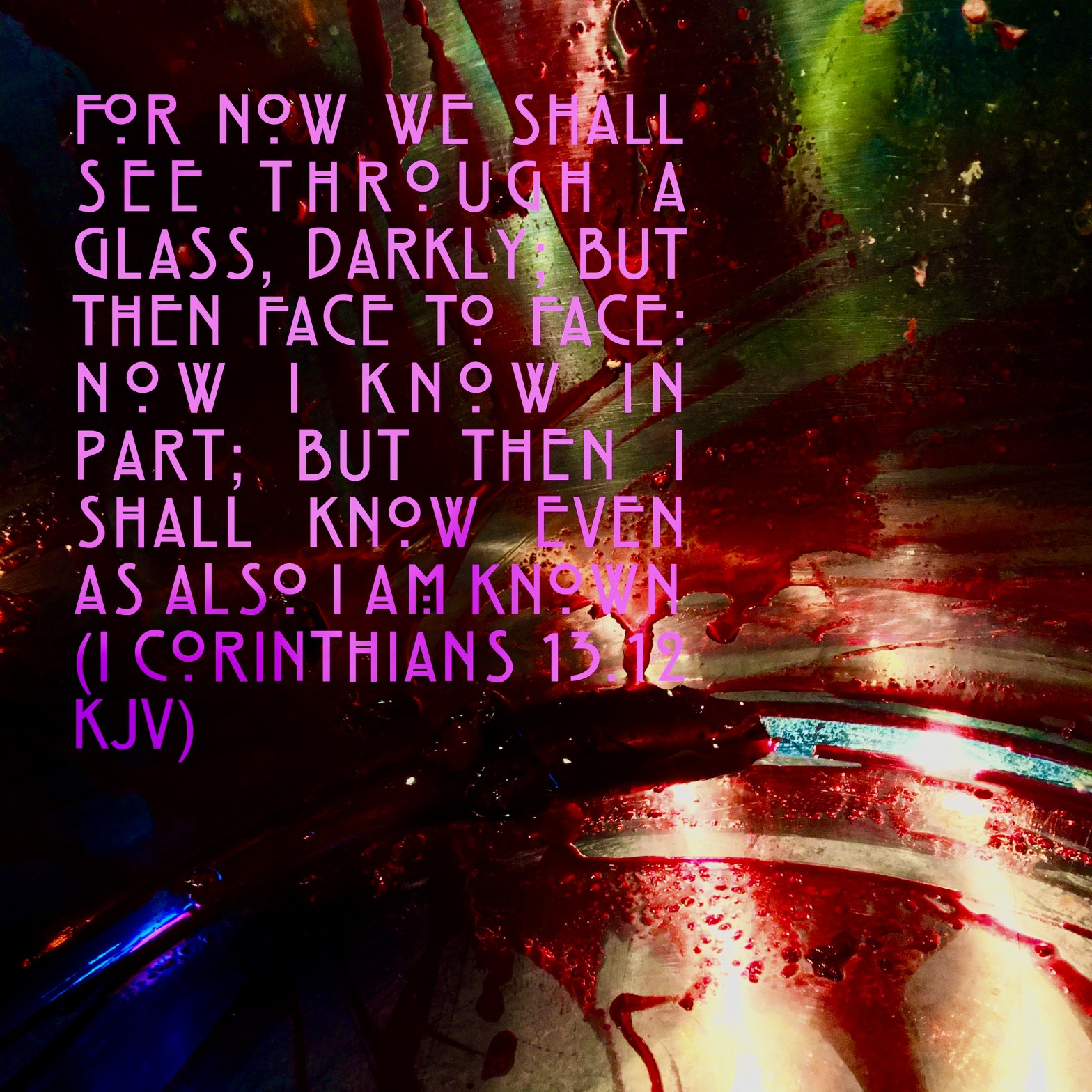
FOR NOW WE SHALL SEE THROUGH A GLASS, DARKLY; BUT THEN FACE TO FACE: NOW I KNOW IN PART; BUT THEN I SHALL KNOW EVEN AS ALSO I AM KNOWN 

(I CORINTHIANS 13.12 KJV)

Rereading the Gospel narratives of the birth of Jesus in preparation for writing this series, I was struck anew by Elizabeth’s story (John the Baptist’s mother).  Elizabeth feels a profound social, physical and spiritual ’disgrace’ because she is not a parent; she feels excluded from her community and isolated from her God.  The subsequent miracle of John’s conception, despite Elizabeth’s age and circumstances, takes her on a new journey of intimacy into God.  

Yet rather than deliberately seeking acceptance from her neighbours, she goes into seclusion.  Elizabeth chooses to prioritise paying attention to her emotional and spiritual wellbeing, as part of her practical preparations before giving birth, over a false sense of communal and social belonging.  She chooses silence.  Elizabeth wants to know God in the same way she is known by God.

For her husband Zechariah, however, the opposite happens, he is struck dumb, unable to fulfil his social and spiritual function as a Temple Priest for the length of the pregnancy.  Even when he was in the Holy of Holies, one of the chosen few to enter there, Zechariah did not recognise the Holy when it was revealed to him.  When he emerged, mute, the congregation chose to interpret his dumbness as a result of seeing ‘a vision’, perhaps they thought he was silent because he was so ‘spiritual’.   Initially Zecharaiah was terrified and overwhelmed to receive a visit from an angel full of prophetic announcements.  However, he soon wanted to ‘know’ more: to know the details, to ask questions, to regain control of the story, to understand how the angel’s word might be trusted.  He stopped listening to the Holy.  He showed that whilst he may have had ‘ears to hear’, he had not heard.

how will I know this is so?

Zechariah’s cry, ‘How will I know that this is so?’ (Luke 1.18) is an utterly understandable human response.  And yet I have a feeling it is not the response of someone who has any sense of God actively being present in his own life at that moment.  For all his priestly duties and status, Zechariah is not prepared to accept God’s word.  He is not prepared to wait and see what happens, which are characteristics of the way of knowingdarkly.  

By wanting a different sort of knowing – more visible, more clear cut, more rational, proof of who God is and what God says God will do – Zechariah cuts himself off from the comfort of any sort of heart-knowing.  By wanting a different sort of knowing, Zecharaiah self-sabotages any prospect he has of expressing a sense of wonder about God, about what he knows, and does not know, about how the Holy is at work in his own world.

blessed is she

It is left to Elizabeth to express wonder and gratitude, saying ‘blessed is she who believed that there would be a fulfilment of what was spoken to her by the Lord’ (Luke 1.45).  It is of great grief to me that I was unable to have children, and I do not understand Elizabeth to be either fulfilled or blessed merely because she had a child.  Elizabeth is able to recognise ‘fulfilment’, wholeness, because she recognises that her seeing relied on her believing that she was a part of the whole of God’s story, even when she could not understand how the details might fit together.  Perhaps it was partly this state that St Augustine was thinking of when he wrote, ’Faith is to believe what you do not yet see; the reward for this faith is to see what you believe’?

God knows I have a need to see and to know, because God is in the very midst of my story, with me.  Seeingdarkly and knowingdarkly are the ways I can begin to communicate that I belong to God, because the very GodSelf is in me.  It is part of my story too, that I am to give birth to the GodSelf; and I can do that by telling others how I am known.  As Annie Dillard said:

You were made and set here

to give voice to this,

your own astonishment.

To be grateful for the good things that happen in our lives is easy, but to be grateful for all of our lives – the good as well as the bad, the moments of joy as well as the moments of sorrow, the successes as well as the failures, the rewards as well as the rejections – that requires hard spiritual work.  Still, we are only truly grateful people when we can say thank you to all that has brought us to the present moment.  As long as we keep dividing our lives between events and people we would like to remember and those we would rather forget, we cannot claim the fullness of our beings as a gift of God to be grateful for.

‘January 12th’, Bread for the Journey, Henri Nouwen

giving voice to astonishment. (iPhone image).

whole: day 14

The quickest way for anyone to reach the sun and the light of day is not to run west, chasing after the setting sun, but to head east, plunging into the darkness until one comes to the sunrise.

Jerry Sittser

dazzle gradually

One of Emily Dickinson’s most famous poems begins ‘Tell all the truth but tell it slant -/ Success in Circuit lies’.  As a way of approaching God, of knowingdarkly, it is the only way to talk about the Unknowable God.  In my contemplative photography project Acts of Daily Seeing ‘Tell it slant’ is also a way of seeingdarkly.  Dickinson goes on to say that ‘The Truth’s superb surprise’ is ‘too bright for our infirm Delight’ to take in all at once; she warns us that it has the power to blind.  There will be no sudden, once-and-for-all revelation until the Christ comes again.  Rather, knowingdarkly and seeingdarkly come together as the Spirit enlightens us as a ‘dazzle gradually’, where the light of revelation brings ‘explanation kind’. 

The Holy has compassion on me: whatever my impatience to know what’s going on, to hear and to see God’s clear direction for my life, God knows that any Wisdom will need to be imparted to me as a slow trickle which I can absorb more easily.  In other words, Wisdom, ‘Truth’, knowing and seeing God, comes through ‘the grace and kindness of the gradual … [since] we cannot cope yet with the fullness of the eternal now’, as Malcolm Guite puts it (‘Emily Dickinson’s desk’, Every Corner Sing (186)).  

Slant and Circuit, Compassion and Grace: this is a pretty good summation of why seeingdarkly and knowingdarkly is the balm for brokenness.  

In this way darkly is not a negative, partial, way of seeing due to a lack of faith. Nor am I being darkly out of some necessary protection for my weak, constrained mortality. Rather, knowingdarkly and seeingdarkly come together as a Grace-given way to encounter the eternal Whole.  

The Whole is always available to be seen, always available to be known, always seeking a loving relationship with me – in my here and in my now. It is up to me to decide if I will risk opening up to let knowingdarkly show me God as God wants me to see and hear God in this day.  

The miracle which awaits me relies on my acceptance.  It is up to me to accept that God is not merely a being outside of me whom I may, or may not, see or know very well: the Unknown God is also at home within me.  It puts a very different ‘slant’ on seeingdarkly and knowingdarkly if, as Robert Browning suggests:

….. to KNOW

Rather consists in opening out a way

Whence the imprisoned splendour may escape,

Than in effecting entry for a light

Supposed to be without…

from Paracelsus I: Paracelsus aspires, Robert Browning

I begin to see an object when I cease to understand it.

Thoreau

imprisoned splendour. iPhone image.

whole: day 13

She who is centered in the Source*

can go where she wishes, without danger.

She perceives the universal harmony,

even amid great pain,

because she has found peace in her heart.

Tao Te Ching ((cited in The Rule of Benedict, Joan Chittister (210))

* This line reads ‘She who is centered in the Tao’ in Chittister’s citation, but I have translated ‘Tao’ here as ‘Source’.

I have recently learnt a little about Sashiko, the Japanese art of stitching patches, either for decorative or functional purposes, whether to mend a hole in a pair of jeans or to make ceremonial quilt.  Single stitches are built up into geometric patterns, and different patches can be layered up to make new fabrics out of old.  It is of necessity a slow and thoughtful, ‘mindful’, art.

It struck me that Sashiko might have something to teach me about knowingdarkly.  Sashiko is about piecing and mending, about new creation, about revelation and resurrection.  Sashiko artists have a type of innate visual intelligence, the ability to glimpse a possibility of a whole to be made out of what is currently only pieces.  

In Visual Intelligence: Sharpen your Perception, Change your Life, Amy E. Herman defines visual intelligence as ‘the ability to see what’s there that others don’t, to see what’s not there that should be, to see the positives and the negatives, the opportunity, the invention, the upside, the warning signs, the quickest way, the way out, the win.’

absorb nuance

Yet if I am to be able to see and know what is whole, what is holy, I am going to need to practice seeing slowly.  As Herman says,

Slowing down doesn’t mean being slow, it just means taking a few minutes to absorb what we are seeing. Details, patterns, relationships, take time to register. Nuances and new information can be missed if we rush past them. Slowing down just a little can change a lot. And in many cases, it’s the small, purpose-filled moments that make all the difference in building relationships, securing business, and winning trust.

Whilst I don’t think in ‘winning’ language, I have found that slower seeing helps knowingdarkly considerably.  Slower seeing allows minute details to emerge in my foreground, others to merge into the background.  I am able to see variation. I am able to glimpse the potential of my patch of the quilt being part of a larger creation, even when I cannot encompass the whole.  Quilting, slow stitching, piecing and patching, all these bring a spiritual function, where each individual stitch, no matter how simple, can become a prayer.  

As an act of both mending and making, prayer is both beautiful and useful.  

Your vision will become clear only when you can look into your own heart.  Who looks outside, dreams; who looks inside, awakes.

Carl Jung

I will believe the truth about myself

no matter how beautiful it is:

I believe in my power

to transform indifference into love.

I believe I have and amazing gift

to keep hope alive in the face of despair.

I believe I have the remarkable skill 

of deleting bitterness from my life.

I believe in my budding potential

to live with a nonviolent heart.

I believe in my passion to speak the truth

even when it isn’t popular.

I believe I have the strength of will

to be peace in a world violence.

I believe in my miraculous capacity

for unconditional love.

I will believe the truth about myself

no matter how beautiful it is.

‘The Truth’

Macrina Wiederkehr

slow marks i. (lino print Kate Kennington Steer)

slow marks ii. (iPhone image)

whole: day 12

It is the whole of nature, extending from the beginning to the end that constitutes the one image of God Who Is.

St Gregory of Nyssa, On the creation of Man

The language of God is life itself, and I live with the unquenchable need to take my life in my hands and try to read the divine alphabet written upon it.

(from Firstlight, Sue Monk Kidd, cited in The Gift of Wonder, Christine Aroney-Sine (97))

How does hearing play a part in knowingdarkly?  I hear God speak to me, though rarely with some ghostly disembodied voice.  God speaks to me through the natural world around me.  God speaks to me through the Bible when I hear a ‘word’ distilled through the practice of Lectio and Visio Divina.  God speaks to me through other people, as likely to be someone in the corner shop as someone in a pulpit.  

I do have a few beloveds who are my ‘kitchen table church’ (though we have never gathered together in one place at one time), whom I trust implicitly to speak to me of what they see God doing in my life, as I speak of where God is in theirs.  

Yet, all the things I hear ‘God’ say, have to be sifted in my heart. They have to be checked and tested to ensure they are full of truth; that they are not the latest list of ‘oughts, musts, shoulds’ from my depressed mind, dressed up in so-called spiritual language. 

darkling I listen*

Knowingdarkly trusts that these sifted ‘hearings’ or shewings (as Julian of Norwich might describe them) are revelations of the Holy breaking into my here and my now.  It is not a question of believing God speaks, but rather of risking what might happen if I listen.

Sit in stillness and listen to what your heart prays.

Ruth Jewell

The heart is always praying,

and we,

as we might call a loved one we’ve not seen,

are to take a moment,

to check in.

To take the pulse,

to register the key in which

our heart is speaking,

to remember,

how prayer,

although it might be a discipline,

is also something within.

The centre of the meeting house,

the unseen, as the air in a room

a structure surrounds.

Yes, the heart has its 

constant murmurings,

a wireless connection,

a tethering itself to home.

And might we, at times,

that we voice the thoughts 

our hearts are always speaking,

find the themes our lives

are following,

and the ways God is responding

to the tears, the casting off of burdens,

to the offerings we’ve put 

forth, like water lilies, 

or candles alight on the sea.

‘Praying’

Ana Lisa de Jong

Living Tree Poetry

November 2019

*from ‘Ode to a Nightingale’, John Keats

vibrations i (Canon 7D. f8. 1/800. ISO 3200)

vibrations ii (Canon 7D. f6. 1/500. ISO 200)

whole: day 11

The truth of what we call our knowing is both light and dark.  Men are always dying and waking.  The rhythm between we call life … I walk in the dark feeling darkness on my skin.  Dawn always begins in the bones.

‘Hymn to Ra’, The Egyptian Book of the Dead

As I am beginning to discover, knowingdarkly is not about what knowledge my mind may have learned, or what stories my mind tells me about myself.  So I wonder if knowingdarkly really begins in my body?  In what I call the ‘wisdom of the gut’?  

When I pause long enough allow myself to see a little more clearly, I realise I am an ‘expert patient’.  Nobody knows better than me, how illness affects my body – and so how my mind, heart and spirit is affected as well.  So nobody knows, better than me, how God-is-with-me, either.  

Knowingdarkly is about taking the risk to trust that, somehow, in someway I may never be able to understand or express, I do know something of God.  Knowingdarkly is trusting that I do know a part of God, a part of Love.  Knowingdarkly is risking looking for a glimpse of the hope of wholeness flickering somewhere deep within my bones.

knowing that we are not separate

When I see you coming toward me, and I know that you are going to offer help, or do something for me, if I am attached and clinging, I brace myself and prepare to say “No, I can do this myself.” I hang on to my pride and I push you away. If I surrender, I look in your eyes and feel your kindness and I melt a bit and say to myself, “let yourself be loved.” I say to you, “thank you.” And once I get over any lingering shame, I feel grateful. The surrendering is hard, but I am discovering that vulnerability is like a muscle that can be strengthened with practice.

So, what is the surrendering to? It is to us; to knowing that we are not separate – that I am you and you are me. It is surrendering to the ever-present force of love and grace that surrounds us all the time like the currents of a river to which we spend most of our time blind and oblivious. We are surrounded by love and kindness and by the Great Spirit, always – this I am discovering. All that is required is to open and say Yes.

Other times I find myself alone and lost, and caught by suffering: physical pain, emotional despair, or mental anguish. When I have enough awareness to notice this state, my big question is: If I am not just this physical, emotional, or mental stuff, then who am I? What is the part of me that is NOT that? The part that knows joy and transcendence, that knows love? Where is that part?

I close my eyes, and enter what seems like a very dark basement with only a flashlight and I begin to search around. Mostly, I encounter the elements of my suffering; my physical discomfort, emotional pain, and my mental maze. So, I keep searching. At some point, I can suddenly see a glimmer of light in some corner and I move toward it. I discover something that is NOT suffering, but is another part of me. I breathe into it and shine my light there. I try to open the crack more. As I do, I find that the light gets brighter and the space gets larger, and if I persist it becomes bright enough to remind me that I am also Spirit and Life and Light. I let that awareness grow until it seems to have the upper hand. The suffering is still present, but no longer “has me.” Instead I am guided by a more essential love-based me that also brings along some suffering – a very different proposition.

from Surrender: The Art of Living, Loving, and Dying Without Training Wheels, Art Shirk

vulnerability is a muscle which glimmers.  (iPhone image)