building joy

In the summer of 2023 I was awarded a bursary from DAiSY (Disability Arts in Surrey) to become artist in residence at the New Ashgate Gallery, Farnham, Surrey.  The brief was to be in an ‘open studio’ situation, welcoming the gallery’s visitors and answering any questions they might have about my work and about creativity in general.  In particular, the New Ashgate wanted someone who could contribute to the gallery’s participation in the national Heritage Open Days scheme (10 days in early September when thousands of volunteers across England organise events to celebrate the UK’s fantastic history and culture; it’s a chance to see hidden places and try out new experiences – all of which are free to explore).  Since Farnham has many listed buildings and a thriving artistic community Heritage Open Days (HOD) are a key part of the town’s calendar every year.  In 2023 the national theme for HOD was ‘creativity’, so the New Ashgate thought it would be ideal to have an artist working in the gallery, whilst people watch and talk to me about my work and creativity in general.   

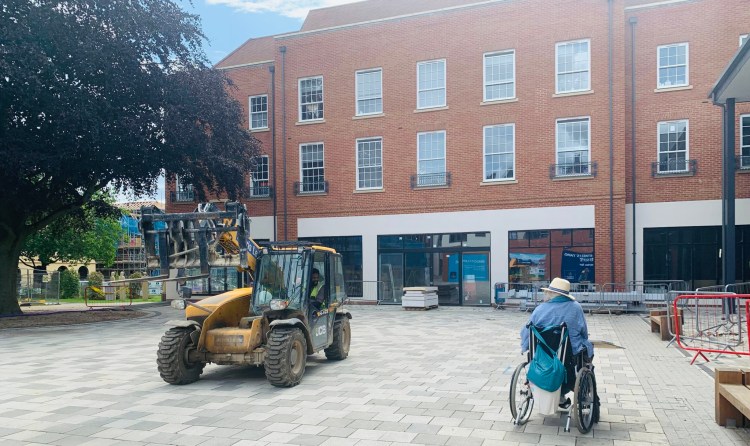
Now, I am a disabled writer, contemplative photographer and mixed-media visual artist, but back in 1997/8, I was Education Director at the Redgrave Theatre.  I was made redundant when the theatre closed because the site was due for commercial redevelopment.  Long story short, the planned development on this site didn’t break ground until 2019, and, in part affected by COVID-19 pandemic and lockdowns, the site was still being built in 2023 and is still unfinished in 2025.  It has been a hugely controversial mixed residential, commercial and retail development by Crest Nicholson, and Farnham has been deeply divided about all aspects of what is now called ‘BrightWells Yard’.  The development is named after BrightWell, the Grade-II listed house which sits at the heart of the site, and which formed part of the Redgrave Theatre when I worked there.  I decided to make this house the centre of my work at the New Ashgate, focussing fascinating conversations with visitors towards the interplay between wellbeing and the built environment.  In artistic terms, I was also trying to find ways of exploring this past connection to the site through combining four P’s on a single (non-digital) surface: poetry, photography, printing and painting (my passions). 
As a result of this personal exploration of my own ‘ghosts’ whilst listening to many of the town’s residents talk about Farnham’s current needs and future housing developments, I decided to begin the bright-+/well project.  This project explores themes around wellbeing and our built surroundings through two pathways.  One is a personal route to understanding my own grief and anger when I re-encountered a place which had played a significant role in my current illness and eventual disability.  The second thread is a community arts engagement route, with free activities to bring new residents together with existing residents and to provide opportunities where new community networks might be forged.   

Last year, in a series of workshops in collaboration with the New Ashgate Gallery called ‘how bright can you go?’, we made 239 mixed-media ‘welcome’ cards: one for every new residence in the BrightWells Yard development.  This year, in conjunction with Toolbox Marketing and Surrey County Council, we are launching ‘BrightWells & Co’: a creative community space in one of the empty shop units in the development.

To mark the opening of this space, and to coincide with national Creativity and Wellbeing week 2025, we are holding a free ‘a yard of joy’ workshop.  We are inviting anyone and everyone to come and make your own mixed-media kite – and fly it.  Let’s fill the sky above this development with symbols of creative freedom, expression and enjoyment, and let’s build community at the same time.  Information about the event can be found at https://www.facebook.com/profile.php?id=61569087720960.  This activity is adaptable for all ages and abilities.  The space is fully accessible.  Full instructions will be given – and again, this activity is free to all comers!  So please spread the word… 

This is just one of the first events for BrightWells & Co.  We are encouraging any local communities who might wish to find a space in which to come together and create, meet or exhibit, to contact us either through the website (https://www.brightwells-farnham.com/whats-here/creative-space/).  My personal explorations with photography, poetry, printing and painting continue, and I have lots of hopes and dreams for the future of the bright-+/well project.  Ultimately I just hope that it will be a positive contribution to Farnham’s future communities.  I continue to be supported by the wonderful teams at the New Ashgate Gallery and Disability Arts in Surrey.  Without their encouragement my life – physically, emotionally and artistically – would be significantly smaller and definitely less purposeful.

This post was written for the Creativity & Wellbeing Festival 2025 https://creativityandwellbeing.org.uk

I am limited

Last week it was my great honour to have another ‘monk in the world’ post published on the Abbey of the Arts Blog. Here is that post:

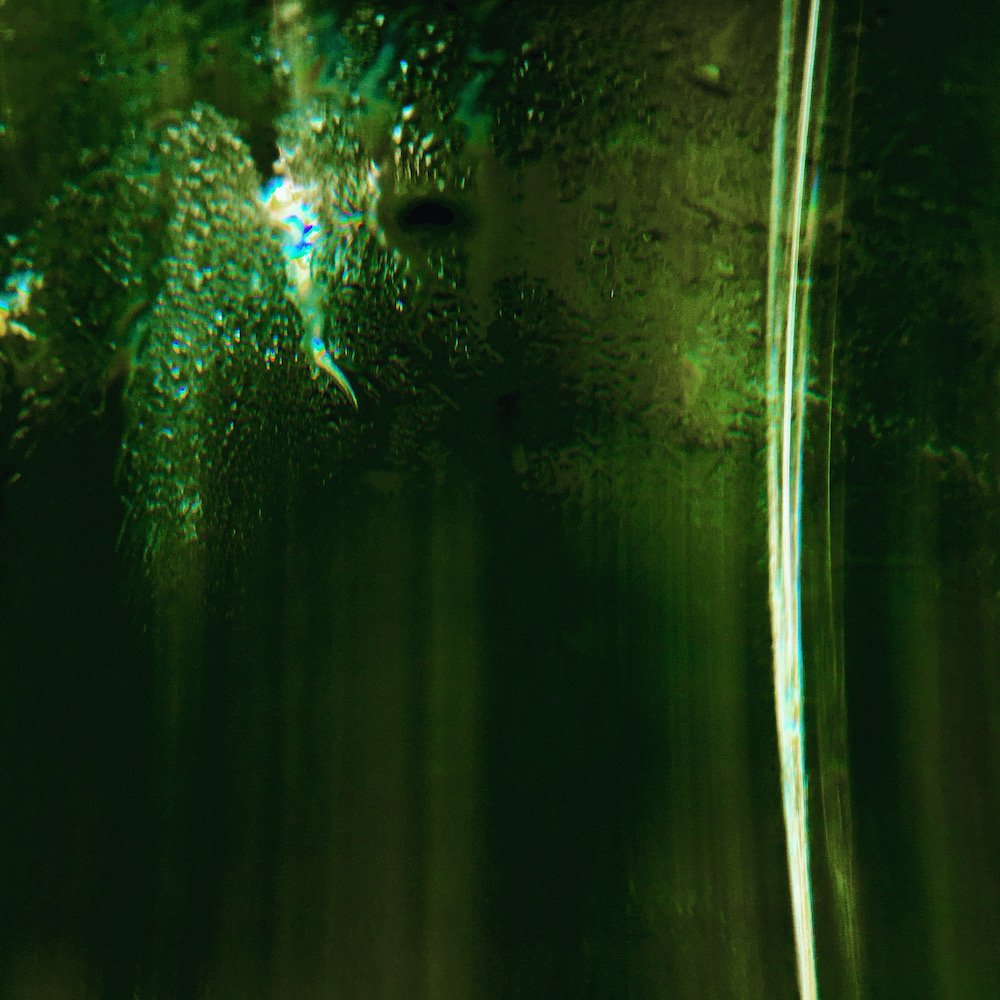
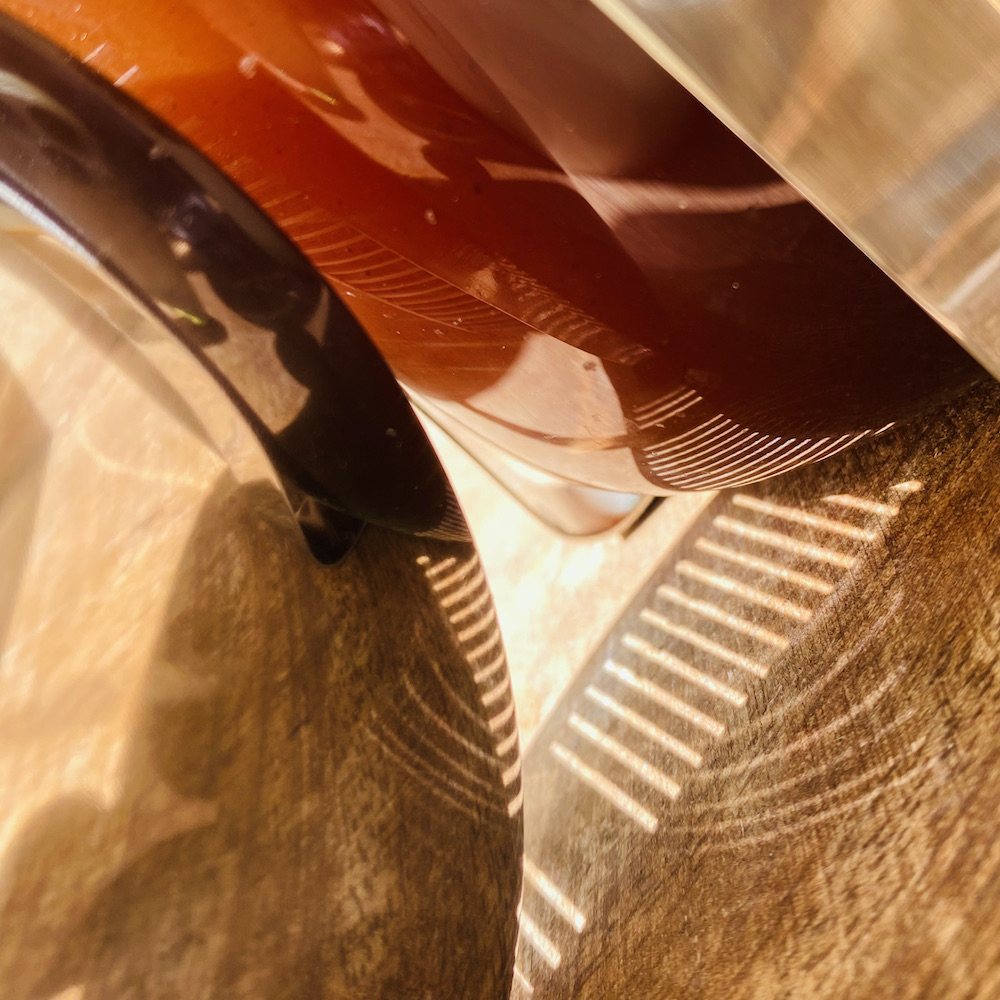
A few months ago I wrote these words in response to a series of photographs (some of which are pictured here) I made in collaboration with the Kinship Photography Collective, for their project ‘between bodies’:

information remains

teasingly just out of reach

behind the darkest 

bottle-green blur of a hedge

or perhaps a single leaf,

here where size is distorted

and volume compacted.

there are limits to this seeing.

I am limited.

so I am compelled to ask

how meaning might be made

from such seemingly 

empty space.

whether I would settle for

even partial revelation

of these enshadowed places,

this mystery

of endarkenment

I apparently need to welcome

if I am to see the light.

for now the gaps and the blanks

have become rest stops,

those breath-gathering places, 

the required pause and hiatus …

Writing the lines ‘there are limits to this seeing/I am limited’ was revolutionary for me.  As was the idea of waiting, open to the moment, attentive to what might want to be expressed through me, to receive images that might defy even my own understanding.  Let’s be honest, images which most people would delete.  

Instead my Kinship practice group encouraged me to make my limitations visible, something I don’t recall ever intentionally doing before.  Normally I end up using long telephoto lenses, so I can crop a picture later in order to get nearer my subject.  This sleight of hand is necessary because I do not have legs that will carry me more than a few steps, and most terrain where I want to go is not wheelchair friendly.

Even though I call myself a contemplative photographer I realised how influenced I remain by the learned mores of the commercial photography we see around us from every screen and billboard. This teaches me to remove myself from the picture.  After all, much of being disabled, or chronically ill, or maybe just being downright poor, isn’t glamorous or photogenic or newsworthy.  We have made a society which turns away from the homeless woman at the end of our home street, whereas to watch survivors of war or famine flee to distant refugee camps is palatable, at least for a short time.  Yet, which picture do I pray over?  Which picture stirs me to action, to enter the struggle for systemic equality where we all might flourish?  Which picture persuades me to save my planet in every way I can – today, right here, right now?

I am limited – by energy, by time, by financial hardship, by pain, by immobility.  I often find I cannot reach far enough to see ‘round’ the pillar or post or person in front of me.  So why do I pretend otherwise?  Why do I too often give up, frustrated?  Isn’t the work of acceptance and surrender, which is at the core of contemplative spirituality, meant to include the way I make my art as well?  Sometimes the person will move and the view opens up.  But often it does not.  And seeing from a wheelchair often dictates that one sees from a limited plane, particularly when it hurts to point a camera up to a too bright sky or to bend down to allow the perfume of the lilies to imbue the lens.  

There is just no point me wasting my precious energy longing to be a mountain-top landscape photographer!   Let that be the work of others.  So, what is my work?   I tell my soul: find a way to show that the possi bilities of the things which limit you are endless.  They are no bar to creating, but rather the frame that others might need to see if they are to see the world through another’s eyes.  They may not be beautiful or easy to see. It may require longer looking. But there is a gleam here, a shape there, a colour tone which surprises and a blank which puzzles.  All are routes into and through the darkness; all are dark joys, dark hopes.

And then I tell my soul, now look for those whose ways of seeing and creating might join with yours.  Look for the collaborators and curators and co-creationists.  And when you find them (and you will), ask them: will you let your limits meet mine for a while and shall we watch our edges dance and see what what might be birthed in their play?

Epiphany 2025: for coming home

It could be the name of a prehistoric beast

that roamed the Paleozoic earth, rising up

on its hind legs to show off its large vocabulary,

or a lover in a myth who gets metamorphosed into a book.

It means treasury, but it is just a place

where words congregate with their relatives,

a big park where hundreds of family reunions

are always being held;

house, home, abode, dwelling, lodgings and digs

all sharing the same picnic basket and thermos;

hairy, hirsute, wooly, furry, fleecy and shaggy

all running a sack race or throwing horseshoes;

inert, static, motionless, fixed and immobile

standing and kneeling in rows for a group photograph.

Here, father is next to sire and brother close

to sibling, separated only by fine shades of meaning.

And every group has its odd cousin, the one

who travelled fo many miles to be here:

astereognosis, polydipsia, or some eleven-

syllable, unpronounceable substitute for the word tool.

Even their own relatives have to squint at their name tags.

I can see my own copy high up on a shelf.

I rarely open it because I know there is no

such thing as a synonym and because I get rattles

around people who always assemble with their own kind, 

forming clubs and nailing signs to closed front doors

while others huddle together in the dark streets.

‘Thesaurus’

Billy Collins

For the past ten years I have followed the annual contemplative practice ‘Give me a Word’, suggested by the Abbey of the Arts.  It is a process of distilling, of discernment, first practised by the Desert Monks in third century Egypt, whose visitors would ask them for a ‘word’ as guidance over their lives.  In 2024 my word was ‘embody/embodied’: a recognition that I live largely in my head, that I have a deeply ambivalent relationship with my (chronically ill/dis-abled) body, my sexuality, my ‘barren’ state, and my body ‘image’.  I keep a running note of random thoughts, resources, quotes around the themes of my word as I come across them during the year. Then at the end of each year I use these notes to write a ‘Credo’, a summation  of what I have learnt.  In doing this, there have been several times that I understood that I had not begun to plumb the depths of my word, and that it needed to be carried over into the next year.  Such is the case with ‘embodied’, and I am hoping to write a series of blog posts here about my journey with this word over the coming year (body permitting).

This year, the place I began was with thinking of my body as a home, with that old truth of the body as a temple, as a house for the soul, and how I need to offer my body deep gratitude and radical hospitality.  I found some surprising congruence in Gaston Bachelard’s Poetics of Space, which I was reading as part of my research thinking behind the bright-+/well project.* Bachelard draws on Victor Hugo’s character of Quasimodo to draw out themes about the relationship between body, mind, spirit and habitation:

For Quasimodo, he says, the cathedral had been successively “egg, nest, house, country and universe.” “One might almost say that he had espoused its form the way a snail does the form of its shell. It was his home, his hole, his envelope. … He adhered to it, as it were, like a turtle to its carapace. This rugged cathedral was his armor.” . “It is useless,” he continues, “to warn the reader not to take literally the figures of speech that I am obliged to use here to express the strange, symmetrical, immediate, almost consubstantial flexibility of man and an edifice.” (111-2)

Bachelard indicates the primitive nature of this need for refuge by citing the painter Vlaminck, who described ”the well-being I feel, seated in front of my fire, while bad weather rages out-of-doors, is entirely animal. A rat in its hole, a rabbit in its burrow, cows in the stable, must all feel the same contentment that I feel.” In talking about the excellence of animal’s nests as patterns for habitation, Bachelard points his readers toward the proverb (113), 

‘men can do everything except build a bird’s nest’ 

I don’t think of myself in animal terms (except perhaps in relation to spirit animals, which is a whole other conversation), so I don’t often think of my home as a nest. I have at times, considered my body as a snail shell: a cumbersome, slow, heavy carapace for my ‘self’. But if I am going to have a hope of being at home with myself, safe and secure in mind and body, such indivisible wholeness will require the kind of pursuit of wellbeing which Vlaminck describes, which includes care of my physical surroundings as an extension of my body.  

It also includes extending the kind of radical hospitality I offer my whole self and my whole house, to others. In The Year As A House: A Blessing, Jan Richardson suggests that I:

Think of the year
as a house:
door flung wide
in welcome,
threshold swept
and waiting,
a graced spaciousness
opening and offering itself
to you.

Let it be blessed
in every room.
Let it be hallowed
in every corner.
Let every nook
be a refuge
and every object
set to holy use.

Let it be here
that safety will rest.
Let it be here
that health will make its home.
Let it be here
that peace will show its face.
Let it be here
that love will find its way.

Here
let the weary come
let the aching come
let the lost come
let the sorrowing come.

Here
let them find their rest
and let them find their soothing
and let them find their place
and let them find their delight.

And may it be
in this house of a year
that the seasons will spin in beauty,
and may it be
in these turning days
that time will spiral with joy.
And may it be
that its rooms will fill
with ordinary grace
and light spill from every window
to welcome the stranger home.

Richardson’s reminders prompt me to remember that the hospitality I offer myself inwardly, needs to be matched by the hospitality I share outwardly – and crucially, vice versa.  (As a Church of England Priest’s daughter, I was brought up to always ‘put others before myself’, but never to reflect on the depth and type of love I needed to have for myself before I could offer it to others). For me, I see my home not so much as nest but rather as sanctuary, as haven, as refuge. And I am fully aware that I am projecting onto the brick walls only the kind of care I need to feel inside my body. 

The Irish Priest John O’Donohue, meets me at that place inside myself where there is a horrible gap, a wide gulf, a bottomless pit.  This has formed out of depressive dissociation between my self image, calcified into something brittle and unlovely over the years, and my True Self  – she who is the Beloved of the Divine, who fully inhabits, is at home with and in, her own body.  In Eternal Echoes O’Donohue says:

Each one of us is alone in the world. It takes great courage to meet the full force of your aloneness. Most of the activity in society is subconsciously designed to quell the voice crying in the wilderness within you. The mystic Thomas à Kempis said that when you go out into the world, you return having lost some of yourself. Until you learn to inhabit your aloneness, the lonely distraction and noise of society will seduce you into false belonging, with which you will only become empty and weary. When you face your aloneness, something begins to happen. Gradually, the sense of bleakness changes into a sense of true belonging. This is a slow and open-ended transition but it is utterly vital in order to come into rhythm with your own individuality. In a sense this is the endless task of finding your true home within your life. It is not narcissistic, for as soon as you rest in the house of your own heart, doors and windows begin to open outwards to the world. No longer on the run from your aloneness, your connections with others become real and creative. You no longer need to covertly scrape affirmation from others or from projects outside yourself. This is slow work; it takes years to bring your mind home.

I am on that journey of returning ‘home’ to my embodied self. And I suspect that beginning this journey with ‘embodied’ over the past year is the reason why my reflections during ‘#adventapertures 2024:make room’ kept returning to the idea of the Incarnation.  That moment when God embodied the GodSelf in flesh and bone and sinew, becoming human, one-with-us.  Such a transformation should shake my world-view (and it does!): for suddenly everything that is ever mattered becomes part of the GodSelf (including ‘dark’ matter, seen and unseen), who becomes a part of me.  The GodSelf partakes of my body. 

Suddenly everything that matters within me is GodSelf too.

May you learn to dwell
Below the surface of the days
At home with the ebb and flow of
Your own heart’s tides.
May you find the womb space at the center of your Life,
There grow wise in the sacred rhythm
Of filling and emptying,
Emptying and filling.
There, held safe,
May you surrender to the unknown
As completely as the dark moon
Empties herself into the secret embrace of her Beloved, the Sun.
There may you cherish hope of renewal
As tenderly as the crescent moon
Cradles the dark in the curve of her arm,
Enfolding, quickening with life new born.
And may you always open to the flow of love
As voluptuously as the moon at full,
Until filled, overflowing, you pour
Love’s gifts out into the world.
So may you grow ever more intimate
With the inward way, the deepening way,
Where filling is emptying, emptying is filling ~
At one with the mystery, at one.

‘A Blessing for the Inward Way’

Tracy Shaw

heart tides. (iPhone image)

  • If you don’t know about the bright-+/well project, then I wrote a series of blogs about it which can be found here.

Watchnight: for growth (unknowing)

I clear the surface of my desk and make a pool of light with my lamp.  I go off to fetch matches and light a candle.  One light is steady and sure, the other uncertain and flickering.  I open my notebook and work between these two poles.  On balance, it’s where I prefer to be: somewhere in the middle.  Certainty is a dead space, in which there’s no more room to grow.  Wavering is painful.  I’m glad to be travelling between the two.

Katherine May, Wintering (94)

Keeping Watchnight as a contemplative practice is very like the experience that May describes above. The clear light of faith of Christmas Day put together with the clear light of memories of the past year, can resolve into a type of certainty.  There is no more room for growth, another year is done.  

Except that, as I’ve been writing about for the past month, the Christian calendar for the year is only just beginning, and in the Celtic Calendar the dark year is less than two months old.  So this night, which I feel is nearly as dark as the Winter Solstice in its capacity for mysticism, is one long opportunity for uncertainty, for wavering, for flickering,  

Watchnight is about pausing to (re)commit all time and space that I inhabit back to the Maker.  It is about rendering all I am and hope to be, all the time and space I hope to inhabit, back to the Maker.

Inevitably then, Watchnight is about discernment, vision, enquiry, listening.  And I have to train my soul for its work in the way I train myself as a contemplative photographer.  As Sugandhi Gadadhar, wildlife filmmaker says,

A camera is just an aid in the process of making an image. The best tools are with you, your eyes and your mind. …Begin to explore your own surroundings – your windowsill, your home garden or local green area, or even the bicycle that you left untouched for days. You never know what wild surprises are in store.

Watchnight is about getting serious with the idea of doing the training, so that I recognise a wild surprise when it is disguised as a scum-scratched pool.  Such seriousness is not a resolution, rather it is a contemplative intention to propel me throughout the next year.  It helps me tune into who I want to be and who I think God wants me be. “Setting intentions is powerful when done properly” says AnnaMarie Houlis in How to Set Intentions :

It is more than setting goals – it is about being purposeful in pursuing your desire… an invitation to step into your preferred story especially when your intentions solidly align with your values. …When setting intentions, it is like laying foundations for what you would like to have, feel and experience, providing you with the opportunity to actively participate in your life the way you want to live it.

Desire and participation are two heavyweight words for me.  I desire to participate in God, in God’s doings here on earth.  I desire to live in the mystical heart of God, amongst the unknowing places of Creation.  Such a desire means I will have to live in the wavering places too, for, too often, that is where the God-With-Us is to found – in the depths of those scum-scratched pools.  Or as the gospel of St John has it, 

The Word became flesh and made his dwelling among us.

Last week, I recommended an interview with Frank Skinner by the Seen and Unseen website.  One of the interviewers, Belle Tindall, went on to unpack some of the themes of their conversation, and I liked her version of the incarnation – the ‘withness’ of God, (to use Samuel Wells’ term):

The Word became flesh and made his dwelling among us.  

That’s the incarnation summed up in ten words. It’s ironic that it would take ten-million words to fully unpack the depth of them, isn’t it? Gosh. John’s such a genius.  

The Word – that’s Jesus – who, as the Prologue goes on to state, is the Son of God, the very source of life itself, and the light of the world. He was present since the beginning, preceding and partaking in the creation of the universe. He, the Word – Jesus – became flesh, and moved into the neighbourhood. And in so doing, he bound together centuries worth of prophecies, predictions, expectations and hopes. The maker squeezed himself into the confines of the made; it is, without a doubt, one of the most outrageous claims that Christianity makes.  

The Word has an accent.  

The Word gets tired.   

The Word burns the roof of his mouth on his food. 

And yet, still God. Always God. The Word of God, with a name and a birthday and a bedtime. Wherever you fall on the whole ‘believing it’ scale, you have to admit, it’s pretty astonishing.  It is a cosmic-sized plot-twist.  

But what if one were to assume that this really happened? If one were to believe that a God who transcends time, space and matter actually made a physical appearance in human history, as Frank Skinner does, then it changes everything. Such a belief leaves nothing untouched, it is utterly un-containable.  

So now I not only need to pay attention to my intention to have eyes open for the wild surprise of the God-Who-Comes, I need to be prepared for the God-With-Us to be uncontainable, to permeate through everything: all I am, all I have, all I desire.  I need to be prepared to accompany God into the wavering places, into all those places where unknowing lies.  But one thing is for certain: when I accompany a God who spills over the edges of any container I might try to put the Holy into, I need to make room for the fact it’s going to get messy, wild and surprising.

Faithful Companion,
In this new year we pray:

to live deeply, with purpose,
to live freely, with detachment,
to live wisely, with humility,
to live justly, with compassion,
to live longingly, with fidelity,
to live mindfully, with awareness,
to live gracefully, with generosity,
to live fully, with enthusiasm.

Help us to hold this vision
and to daily renew it in our hearts,
becoming ever more one with you,
our truest Selves.

Amen.

from Out of the Ordinary

Sister Joyce Rupp

Suppose I took out a slender ketch from

under the spokes of Palace pier tonight to

catch a sea going fish for you

or dressed in antique goggles and wings and

flew down through sycamore leaves into the park

or luminescent through some planetary strike

put one delicate flamingo leg over the sill of your lab

Could I surprise you? or would you insist on

keeping a pattern to link every transfiguration?

Listen, I shall have to whisper it 

into your heart directly: we are all

supernatural / every day

we rise new creatures / cannot be predicted

Anniversary’

Elaine Feinstein

scum-scuffed-scratches. (iPhone image)

Christmas Day: for birth

Light splashed this morning 

on the shell-pink anemones

swaying on their tall stems;

down blue-spiked veronica 

light flowed in rivulets

over the humps of the honeybees;

this morning I saw light kiss 

the silk of the roses 

in their second flowering.

my late bloomers 

flushed with their brandy.

A curious gladness shook me.

So I have shut the doors of my house, 

so I have trudged downstairs to my cell,

so I am sitting in semi-dark 

hunched over my desk 

with nothing for a view 

to tempt me

but a bloated compost heap, 

steamy old stinkpile, 

under my window;

and I pick my notebook up 

and I start to read aloud 

the still-wet words I scribbled 

on the blotted page: 

“Light splashed…”

I can scarcely wait till tomorrow 

when a new life begins for me, 

as it does each day,

as it does each day.

‘The Round’

Stanley Kunitz

O God-With-Us may I not turn You away today, be so busy filling my day with so much joy of Who-I-think-You-Are, that I say unwittingly, again, there is no room for You-the-I-AM here in my life.  

O God-Who-Comes, who came, who is coming into the dark corners of my life, the place where I haven’t yet made room for You, rebirth me gently, I pray.  In the quiet echoes of my disquiet, rebirth me gently I pray.  In the rough places, the stinking compost piles of my waste, rebirth me gently I pray.  

O God-With-Us, rebirth me so I may encounter You this day.  

Some-how, some-where, O God-Who-Is, be born in me today.

Christmas declares the glory of the flesh:
And therefore a European might wish
To celebrate it not at midwinter but in spring, when physical life is strong,
When the consent to live is forced even on the young,
Juice is in the soil, the leaf, the vein,
Sugar flows to movement in limbs and brain.
Also before a birth, nourishing the child
We turn again to the earth
With unusual longing – to what is rich, wild,
Substantial: scents that have been stored and strengthened
In apple lofts, the underwash of woods, and in barns;
Drawn through the lengthened root; pungent cones
(While the fir wood stands waiting; the beech wood aspiring,
each in a different silence), and breaking out in spring
with scent sight sound indivisible in song.

Yet if you think again
It is good that Christmas comes at the dark dream of the year
That might wish to sleep ever.
For birth is awaking, birth is effort and pain;
And now at midwinter are hints, inklings
(Sodden primrose, honeysuckle greening)
That sleep must be broken.
To bear new life or learn to live is an exacting joy:
The whole self must waken; you cannot predict the way
It will happen, or master the responses beforehand.
For any birth makes an inconvenient demand;
Like all holy things
It is frequently a nuisance, and its needs never end;

Freedom it brings: we should welcome release
From its long merciless rehearsal of peace.

So Christ comes,
At the iron senseless time, comes
To force the glory into frozen veins:
His warmth makes
Green life glazed in the pool, wakes
All calm and crystal trance with the living pains.

And each year
In seasonal growth is good – year
That lacking love is a stale story at best
By God’s birth
Our common birth is holy; birth
Is all at Christmas time and wholly blest.

‘Christmas and the Common Birth’ 

Anne Ridler

green life glazed wakes. (iPhone image)

Christmas Eve: for reframing

Totally conscious, and apropos of nothing, you come to me.
Is someone here? I ask.
The moon. The full moon is inside your house.

My friends and I go running out into the street.
I’m in here, comes a voice from the house,
but we aren’t listening.

We’re looking up at the sky.
My pet nightingale sobs like a drunk in the garden.
Ringdoves scatter with small cries, Where, Where.

It’s midnight. The whole neighbourhood
is up and out in the street
thinking, The cat burglar has come back.
The actual thief is there too, saying out loud,
Yes, the cat burglar is somewhere in this crowd.
No one pays attention.

Lo, I am with you always means when you look for God,
God is in the look of your eyes,
in the thought of looking, nearer to you than your self,
or things that have happened to you
There’s no need to go outside.
Be melting snow.
Wash yourself of yourself.

A white flower grows in the quietness.
Let your tongue become that flower.

Jalaluddin Rumi (translated by Coleman Barks)

In her article, Reframe the Picture, Shanti Natania Grace relates the following anecdote:

When John F. Kennedy visited NASA in 1962 he talked with many people there.  Each one told him about their jobs, with various details of the day-to-day.  But when he met a janitor in the hallway and asked him what he did for NASA, the man replied “I’m helping put a man on the moon.”

Each day we have the opportunity to understand and reframe our thoughts and perspectives.  We tend to have a running monologue describing and evaluating who we are and what we are doing, and we seldom stop to question it.  Then we relate to ourselves and others through the frame of that description.  Yet it’s always possible – and often much more accurate – to reframe the description in other ways.  Reframing is not a denial of the facts, it accepts the actuality of whatever’s going on and then expands the view to include a wider picture.

The man who replied “I’m helping put a man on the moon,” framed his work in a larger context; he valued himself and his contribution, and he saw the truth of the interdependence and value of everyone who worked there. 

Making room for reframing means stopping and questioning my own perspective, and acknowledging my own blinkers, filters and prejudices.  My default viewpoint, where ‘I’ am the subject of every moment, where everything revolves around ‘me’, gets challenged when I read about the deep listening practised by Pauline Oliveros, for example:

When you enter an environment where there are birds, insects or animals, they are listening to you completely.  You are received.  Your presence may be the difference between life and death for the creatures of the environment.  Listening is survival.  

To be ‘received’ by a bird is humbling.  I wonder what it is like to be received by an angel?  

Here, in ‘The Spirit of Elijah (Luke 1.14-18), Drew Jackson writes of the angel Gabriel and the prophets that confront injustice with God’s healing power: 

I’ve been told that God shows up  
on shores, in boats, with Bibles  
and swords. 

I’ve been told that God does  
the bidding of kings  
seeking to plant their flag on my soil. 

I’ve been told that God snuggles up to  
power that delights to  
kill bodies like mine.   

But that’s not what Gabriel said.  

Gabriel said that God’s prophet  
will have the spirit of Elijah,  
bringing life to widows’ households.  

Gabriel said that God’s prophet  
will possess the power of the Tishbite,  
tearing down monuments to the god of domination.  

Gabriel said that God’s prophet  
will be filled with the Holy Spirit,  
committed to speaking out against Ahabs and Jezebels.  

Thus saith the LORD. 

Gabriel certainly challenged Zechariah’s point of view by telling him that he would be the father of John the Baptist.  Later in Luke 1 Gabriel is sent to Mary, telling her she was to give birth to the Christ.  That rocked her worldview, to put it mildly.  In Luke 2, angels freak out shepherds above Bethlehem, telling them where to find God, thus changing their lives for ever.  The God-Who-Comes needs me to make room in my tiny mind and to prepare to be shocked out of what I think I know, if I am to even glimpse even an iota of the truth about how the God-Who-Is, is the God-Who-is-Coming; about how the God-With-Us will be with me for all time. 

Am I ready?

She was young,

but not too young to know.

She would have seen the soldiers 

marching along the road.

She would have heard, late at night, the elders 

still spinning the old tales – 

slavery; liberation; exile; oppression.

She would have listened to the whispers 

of a final redemption.

I wonder if she believed –

if such rumours of light could take flight 

after such long and bitter centuries?

I wonder how she felt 

when she was told.

‘Mary’

Gideon Heugh

questioning the running monologue. (iPhone photo)

day 23: for gratitude

If you find yourself half naked
and barefoot in the frosty grass, hearing,
again, the earth’s great, sonorous moan that says
you are the air of the now and gone, that says
all you love will turn to dust,
and will meet you there, do not
raise your fist. Do not raise
your small voice against it. And do not
take cover. Instead, curl your toes
into the grass, watch the cloud
ascending from your lips. Walk
through the garden’s dormant splendor.
Say only, thank you.
Thank you.

‘Thank You’

Ross Gay

I try to begin every day by writing ‘Grace Notes’, which is my version of a gratitude practice.  Each day I begin by noting at least three things for which I am thankful.  It might be for being well enough to paint the previous day, or how the sun is falling toward the house through the trees, or that I had a nice phone conversation with a friend.  What this does is to remind me, before I begin my day, that all and everything is gift.  That all and everything is gift received from the God-Who-Gives.  That stops my internal braggart from claiming she is brilliant all by her self.  It stops my internal poor widow from moaning about the lack of everything.  It stops all my internal parts whipping themselves into a frenzy of anxiety that I have not got enough, that I have not done enough, that I am not enough.

In The Gifts of Imperfection sociologist Brené Brown cites Lynne Twist about the myth of scarcity. Twist writes,

For me, and for many of us, our first waking thought of the day is “I didn’t get enough sleep.” The next one is “I don’t have enough time.” Whether true or not, that thought of not enough occurs to us automatically before we even think to question or examine it. We spend most of the hours and the days of our lives hearing, explaining, complaining, or worrying about what we don’t have enough of. … We don’t have enough exercise. We don’t have enough work. We don’t have enough profits. We don’t have enough power. We don’t have enough wilderness. We don’t have enough weekends. Of course, we don’t have enough money – ever.

We’re not thin enough, we’re not smart enough, we’re not pretty enough or fit enough or educated or successful enough, or rich enough – ever. Before we even sit up in bed, before our feet touch the floor, we’re already inadequate, already behind, already losing, already lacking something. And by the time we go to bed at night, our minds race with a litany of what we didn’t get, or didn’t get done, that day. We go to sleep burdened by those thoughts and wake up to the reverie of lack. … What begins as a simple expression of the hurried life, or even the challenged life, grows into the great justification for an unfulfilled life.

Letting go of this mindset of scarcity, and undoing its pernicious logic can only be done by a reset that has gratitude at its heart.  If I allow gratitude to do its daily work,

we discover the surprising truth of sufficiency. By sufficiency, I don’t mean a quantity of anything.  Sufficiency isn’t two steps up from poverty or one step short of abundance. It isn’t a measure of barely enough or more than enough. Sufficiency isn’t an amount at all. It is an experience, a context we generate, a declaration, a knowing that there is enough, and that we are enough. …. It is a consciousness, an attention, an intentional choosing of the way we think about our circumstances. (109-10)

As a Christian contemplative, paying attention to changing my mindset, and setting of a daily intention to help me do that, reveals a deep longing in me to make that gratitude personal.  I thank the I AM, the God-Who-Is.  Such a simple prayer takes me into the heart of God.  It’s like a compulsion, a reflex.  You, the God-Who-Gives are all; and because You come, are made manifest in matter over and over, I not just exist, not just subsist, but I am. 

In You I live and have my being, as the old prayer goes.  All of me thanks the All of You.

When I can no longer say thank you
for this new day and the waking into it,
for the cold scrape of the kitchen chair
and the ticking of the space heater glowing
orange as it warms the floor near my feet,
I know it is because I’ve been fooled again
by the selfish, unruly man who lives in me
and believes he deserves only safety
and comfort. But if I pause as I do now,
and watch the streetlights outside winking
off one by one like old men closing their
cloudy eyes, if I listen to my tired neighbors
slamming car doors hard against the morning
and see the steaming coffee in their mugs
kissing their chapped lips as they sip and
exhale each of their worries white into
the icy air around their faces—then I can
remember this one life is a gift each of us
was handed and told to open: Untie the bow
and tear off the paper, look inside
and be grateful for whatever you find
even if it is only the scent of a tangerine
that lingers on the fingers long after
you’ve finished eating it.

‘Winter Morning’

James Crews

Listen to James read his poem here.

just this (how colour arranges itself) (iPhone photo)

Sunday 4: for waiting

 Do this work until you feel the delight of it. In the trying is the desire. The first time you practice contemplation, you’ll only experience a darkness, like a cloud of unknowing. You won’t know what this is. You’ll only know that in your will you feel a simple reaching out to God. You must also know that this darkness and this cloud will always be between you and your God, whatever you do. They will always keep you from seeing [God] clearly by the light of understanding in your intellect and will block you from feeling [God] fully in the sweetness of love in your emotions. So, be sure you make your home in this darkness. Stay there as long as you can, crying out to [God] over and over again, because you love [God]. It’s the closest you can get to God here on earth, by waiting in this darkness and in this cloud. Work at this diligently, as I’ve asked you to, and I know God’s mercy will lead you there.

from The Cloud of Unknowing

Waiting for the God-Who-Comes is no easy task.  It’s unsettling to feel that I am incomplete until x happens, or I am y age.  Sue Monk Kidd, in her book When the Heart Waits, has written extensively about this uneasiness.  She points out that in soulmaking I cannot bypass the cocoon stage if I want to unfurl my wings and fly:

I had tended to view waiting as mere passivity. When I looked it up in my dictionary however, I found that the words passive and passion come from the same Latin root, pati, which means “to endure.” Waiting is thus both passive and passionate. It’s a vibrant, contemplative work. It means descending into self, into God, into the deeper labyrinths of prayer. It involves listening to disinherited voices within, facing the wounded holes in the soul, the denied and undiscovered, the places one lives falsely. It means struggling with the vision of who we really are in God and molding the courage to live that vision.

Such active waiting involves the combination of patience and anticipation.  Staying on the edge between these two is the work of contemplation, as the fourteenth-century text The Cloud of Unknowing, reveals (quoted above). Deliberately being willing to stay in my dark places because it is there I will find God-With-Us is tough.  Christmas is still a few days away, and I need to know again – and be prepared to stay in – the gap between the God-Who-Is, the I AM, the Immanuel, and the apocalyptic act of the incarnation that Christmas Day marks: the God-Who-Comes and Who-will-keep-coming.  This is the God who I keep reaching out toward.

Holding these mystical paradoxes together is part of the work of waiting, of contemplation, of soulmaking. It is a poetic act of living, of making, of becoming one with The Maker, as comedian Frank Skinner often discusses on his poetry podcast.  In an interview with the website Seen and Unseen, Frank states that,

“Christianity is like living the poem… it’s like the Old Testament was a collection of poetry, I’m not saying that there’s no factual stuff within it, but clearly it’s written in a poetic style, with great truths and insights into human nature. And then, with that whole phrase, “The Word became flesh”, it’s like now the poetry gets real, there’s going to be a poem that lives, and it’s all going to make sense…  this is super-poetry, this is poetry that’s actually physical, it actually exists.”  Frank goes on to suggest that we’ve lost sight of this, that humanity have forgotten, or perhaps never fully grasped, that we exist because of this super-poetry, that we exist within it, that “there’s a line waiting just for us”.  

Now the poetry gets real.  That is what we are waiting to celebrate again, and for the first time: that moment where all matter, including me, becomes unified in the flesh of the Christ; where human and divine meet, where all matter in the history of the universe meets in the body of the God-Who-Lives.

Today I am asked to make room to wait and anticipate because ‘The Word became flesh and made his dwelling among us’ (John 1).  I need to make room because God wants to write poetry in me. 

When the peaks of our sky come together

my house will have a roof

Paul Eluard, Dignes de Vivre

an empty path throngs. (Conon &D. 1/25. f9. ISO 100.)

Blue Christmas: for mourning

Grief is a response to an irreversible loss… To generate grief rather than sadness, the thing lost must carry great emotional weight, and it must pull back the veil that covers a transcendent aspect of the world. Breathe out to push the fog away from a brilliant pinpoint of light. … Gravity holds my feet on the ground. Gravity keeps the earth traveling around the sun, the sun dancing around the galaxy, the galaxy threading through the Local Group, and on and on. Gravity pulls rain out of the sky. And snowflakes. And leaves in autumn. And tears from my eyes when I knew you really are gone. Where did you go?… The distance between here and there is the answer to the wrong question. …I thought gravity pulled my mind into the past, stuck in memories. But now I know I can’t trust memories. Some are invented, all are edited. The whole web of who I am — what I’ve seen and done, what skills I’ve found — is nothing but fog. Gravity pulls me to the future, bits of me falling off along the way. Each of us disappears into the mist of the possible. In our minds, time is gravity’s other side.

Michael Frame, Geometry of Grief

During this past year, regular readers of this blog will know that I’ve been working on the bright-+/well project, looking at wellbeing and the built environment.  This year’s Advent theme, ‘make room’, partly arose from that too.  As a result of my research, I have been made very aware of all that has been demolished and knocked down and destroyed in the last year – whether that is a home, a community, a neighbourhood, a city, a country – whether that is through commercial development, war or ecological disaster.  I am also aware that institutions and values are also being undermined through a wide variety of causes – whether that is democracy, the United Nations, or the Church of England and Anglican Communion.  Many people have been left without a place of safety, a home, or a community to which they can feel they ‘belong’, or have been left feeling ‘stripped’ of frameworks from which they previously drew strength.  

One of the reasons of writing this series then, is the need to ‘make room for…’ a whole host of values – whether that be as individuals – internally, emotionally, physically, spiritually, mentally – or as a community.  Part of making that room is about thinking in detail in physical as well as metaphorical terms about what we build as a society, as well as for whom and for why and how.  But before I can build, I have to acknowledge the empty space, to see what was lost, why, how and by whom.  Making room to grieve all this is vital.

Today is the Winter Solstice, the Shortest Day where it feels like darkness might overwhelm light.  In response I have adopted the tradition of celebrating Blue Christmas on this day: for all those who are (or feel) alone, who are (or feel) homeless, who are grieving, are desperate, are sick, are (or feel) powerless.

When I mourn no one can tell me how long I will need to grieve.  No one can tell me the depth of my grief.  No one can rush me into a spiritual bypass, that tells me the time for mourning is over.  Mourning is a part of living the both/and of life – every minute someone is mourning just as someone else is dancing – to a greater or lesser degree.  Mourning is an acknowledgement of loss at the same time as recognising that life continues.  Grieving is entering the unknown: willingly entering into, rather than resisting, a time I want to flee from; willingly remaining present during a time every fibre in my being tells me I do not want to undergo.  Howard Thurman, the American Civil Rights Leader, Baptist Minister and theologian put it like this when he wrote the prayer/poem ‘I will Light Candles’ during the 1950s:

I will light candles this Christmas;

candles of joy despite all sadness,

candles of hope where despair keeps watch,

candles of courage for fears ever present

candles of peace for tempest tossed days

candles of grace to ease heavy burdens

candles of love to inspire all our living,

candles that will burn all the year long.

Thurman encapsulates the courage that’s needed to live the both/and.  To make room for grief, then, is to make room for the sudden delight that might emerge.  It may not touch the feeling of grief, and yet, I am changed by the arrival of something I need to pay attention to in that moment.  The novelist/essayist Barbara Kingsolver wrote ‘My Desert Pond’ about being willing to make room for these moments of encounter with the both/and of life:

What to believe in, exactly, may never turn out to be half as important as the daring act of belief. A willingness to participate in sunlight, and the color red. An agreement to enter into a conspiracy with life, on behalf of both frog and snake, the predator and the prey, in order to come away changed.

‘A willingness to participate in sunlight’ may or may not ease my actual feelings of loss, but what the Shortest Day/Longest Night demonstrates is the infinitesimal gradations that it takes to achieve balance.  It shows us that change always comes.  This moment I am full of grief, the next moment I am full of aliveness that a change in the quality of the light can bring out in me.  Both are equally true.  I live in the messy, unknowing place, making room for grief and whatever needs to show up in me in the next second, the next day, the next year.  

The point about Christmas is that God-With-Us lives here too.

‘Lesson i’

The desert is powerless

when thunder shakes the hot air 

and unfamiliar raindrops slide 

on rocks, sand, mesquite, 

when unfamiliar raindrops overwhelm 

her, distort her face.  

But after the storm, she breathes deeply, 

caressed by a fresh sweet calm.  

My mother smiles rainbows.  

When I feel shaken, powerless 

to stop my bruising sadness 

I hear My Mother whisper: 

Mi’ja* 

don’t fear your hot tears 

cry away the storm, then listen, listen.

‘Lesson ii’

Small, white fairies dance

on the Rio Grande.  Usually they swim

deep through their days and nights

hiding from our eyes, but when the white

sun pulls them up, up

they leap about, tiny shimmering stars.

The desert says: feel the sun

luring you from your dark, sad waters,

burst through the surface

dance

Pat Mora, from Chants (1984)

* Mi’ja is Spanish for ‘my daughter’

a room for what is gone. (iPhone image)

day 20: for nourishment

In winter, we are prone to regard our trees as cold, bare, and dreary; and we bid them wait until they are again clothed in verdure before we may accord to them comradeship. However, it is during this winter resting time that the tree stands revealed to the uttermost, ready to give its most intimate confidences to those who love it. It is indeed a superficial acquaintance that depends upon the garb worn for half the year; and to those who know them, the trees display even more individuality in the winter than in the summer. The summer is the tree’s period of reticence, when, behind its mysterious veil of green, it is so busy with its own life processes that it has no time for confidences, and may only now and then fling us a friendly greeting.

This is the time of year when my Seasonal Affected Disorder (SAD) is at its worst.  As I’ve been writing this series here in the UK we’ve been experiencing several weeks of very heavy grey cloud, a kind of muffled blanket.  It makes the quality of the light feel dirty, and there has been no relief as the days get shorter and the nights seem to begin in the middle of the afternoon.

Last Winter I collected around myself several helpful resources to help me understand how to allow myself to be ‘fallow’.  One of these was an e-course from Abbey of the Arts which has just been published in book form as A Midwinter God by Christine Valters Paintner (in which one of my poems also features!).  The other was an excellent book, Wintering: The Power of Rest and Retreat in Difficult Times by Katherine May. May reminded me that, 

Plants and animals don’t fight the winter; they don’t pretend it’s not happening and attempt to carry on living the same lives they lived in the summer. They prepare. They adapt. They perform extraordinary acts of metamorphosis to get them through. Wintering is a time of withdrawing from the world, maximizing scant resources, carrying out acts of brutal efficiency and vanishing from sight; but that’s where the transformation occurs. Winter is not the death of the life cycle, but its crucible.

It’s a time for reflection and recuperation, for slow replenishment, for putting your house in order.

Doing these deeply unfashionable things — slowing down, letting your spare time expand, getting enough sleep, resting — is a radical act now, but it’s essential.

It sometimes feels like I do nothing but rest.  But I know that often, I am not truly resting in mind, body and spirit – I am not letting go.  I may be lying down in body, but my mind can churn with frustration that I’m not painting.  I may try to go to sleep at a reasonable hour, but I remain unable to remember my dreams, to receive and hear their wisdom.

Pretending that it’s not happening, not being present to the need to slow down and savour, that is treating winter as my death-cycle. I need to practice a volte-face in the face of diminishing light: to see it as the gift of increasing dark, of mystery, of unknowing, of the fallow time utterly necessary to the generative cycle, to any productivity I might wish to see in my life to come.  I need to welcome the pause, and see it as a time not of scarcity, but of abundant preparation.

If I am to receive nourishment from the season, from my inner life, from my body, from my dreams, I need to surrender to the need to rest in such a way that I might be replenished; that I become content to lie fallow and unproductive; that I can yield my whole being into the will of the God-Who-Is-With-Me.  Then I might be able to extend such nourishment to others.  For as the Japanese proverb says, ‘one kind word can warm three winter months’.

If you suddenly and unexpectedly feel joy, don’t hesitate. Give in to it. There are plenty of lives and whole towns destroyed or about to be. We are not wise, and not very often kind. And much can never be redeemed. Still, life has some possibility left. Perhaps this is its way of fighting back, that sometimes something happens better than all the riches or power in the world. It could be anything, but very likely you notice it in the instant when love begins. Anyway, that’s often the case. Anyway, whatever it is, don’t be afraid of its plenty. Joy is not made to be a crumb.

‘Don’t Hesitate’

Mary Oliver

joy is not made to be a crumb. (iPhone image)