On the first day of Christmas, they hauled you from me
with the forceps while a crimson Santa blinked outside
and made the rain new blood.
The second day, I washed with frankincense, fed you
thin gold, summoned by the high star of your cry. The third day,
milk came swaddling-pale, shepherd’s flock white.
The fourth, the fifth, I wept like a child awake
past bedtime, willing the morning close.
On the sixth day, my body was a spruce tree
and you were tinsel, wound around my ribs,
my lungs, my grateful neck. Then came days
with countless nights, nights by the window
watching sleep fly over slanting roofs outside,
its reindeer legs, its glossy chariot. By the twentieth,
you slept, prone angel on my chest.
On the twenty-first, your father was the year’s first snow
to me. Then came the carol of your voice, then
your hands at the door of my heart
and here we are, the twenty-fourth, your fairy-lit eyes,
pursed lips, the snowflakes of your fingertips
and all of you a gift that I will not unwrap
just hold and hold in my forgotten hands
weighing you silently,
trying to guess what you are.
‘Advent’,
Helen Mort, The Illustrated Woman (41)
As part of their homage, the Wise-Ones bring their treasures to the child who caused the ChristStar to rise. Whether they brought these from home, or gathered them along the trade routes as they journeyed does not matter, the wealth they gave Mary as a result of beholding the new King of the Jews, was extravagant by any measure. Francincense. Gold. Myrrh. Not practical gifts but ceremonial gifts. Gifts of status. Gifts of worship, common to religions across the world. The Wise-Ones brought the GodChild their best offerings.
Trebbe Johnson, in her book Radical Joy for Hard Times, has a wonderful section on gifts and the art of giving:
A great gift is not meant to be practical. The literary deconstructionist Jacques Derrida wrote that an element of excessiveness is in fact, an inherent quality of the gift, which ought to be “the extraor-dinary, the unusual, the strange, the extravagant, the absurd, the mad.” … it is the one action that any person can undertake in any circumstance. …Remedies and tools are vital, but they are different from strange, magnificent gifts. A gift is an expression of an emotion, like a kiss, a laugh, or the urge to go to the aid of someone who has tripped and fallen on the sidewalk. It is not a first step toward an outcome but an urgent command from now. It is by nature excessive.
…
Nipun Mehta founded Service Space, a nonprofit organization devoted to the principle that people are inherenty generous and that small acts of generosity can change old addictive patterns of consumerism into new impulses to contribute. The organization’s website invites people around the world to submit stories about the effect of generosity in their lives. Mehta explains:
Giving changes the deep habit of my mind from everything being me-centered. In that brief moment, there is this other-centeredness. That other-centeredness kind of relaxes the patterns of the ego. Over time, all of those small acts, those small moments, lead to a different state of being where, ultimately, presumably, it just becomes effortless. It becomes who you are. (162-3)
Johnson analyses the reciprocal exchange which happens when I give to another:
When I give … I, the giver, recognize myself as someone capable of providing a boon for another and, at the same time, I see my recipient as one worthy of receiving that gift. The value of each rises, in my perception. And, as [Lewis] Hyde notes, it becomes harder to ignore, trash, shun, or otherwise treat carelessly that with which I have formed such a compact. (164)
Yet the Wise-Ones actions take me one step further: they demonstrate that it is possible that I may give to God. My worship is not just words, nor is it merely things or money. My actions are not empty and meaningless. I do not praise God as King because I have to. I choose an excessive act because the fact of the Incarnation, the Great Gift itself, is excessive: the GodSelf is given to me. What I can render in return will never be enough. But God freed me from that compulsion, I do not even have to attempt it.
That is the freeing gift of Grace.
Through Grace any gift I make is transformed into not just ‘enough’, but more.
So I offer as gift all I am – which is not nothing or even ‘little’ compared with gold, frankincense and myrrh, but is everything in God’s eyes. I am not made ‘poor’ by comparison to the world’s riches or treasures, but am transfigured into the most valuable piece of matter in the universe.
This then brings a slightly different emphasis to the last verse of the familiar text of Christina Rosetti’s poem ‘In the bleak midwinter’:
What can I give him,
poor as I am?
If I were a shepherd,
I would bring a lamb,
if I were a wise man
I would do my part,
yet what I can I give him,
give my heart.
Giving the GodSelf my heart completes the circle: I give the indwelling GodSelf in me back to the whole. I am brought into communion with the Holy One and with all the saints. To present God with the gift of my heart is an urgent and reverent necessity: it makes me the richer and makes the world a better place.
We desperately need to retrieve our capacity for reverence. Each day that is given to you is full of the shy graciousness of divine tenderness. It is a valuable practice at night to spend a little while revisiting the invisible sanctuaries of your lived day.
Each day is a secret story woven around the radiant heart of wonder. We let our days fall away like empty shells and miss all the treasure.
John O’Donohue, Eternal Echoes, (110)

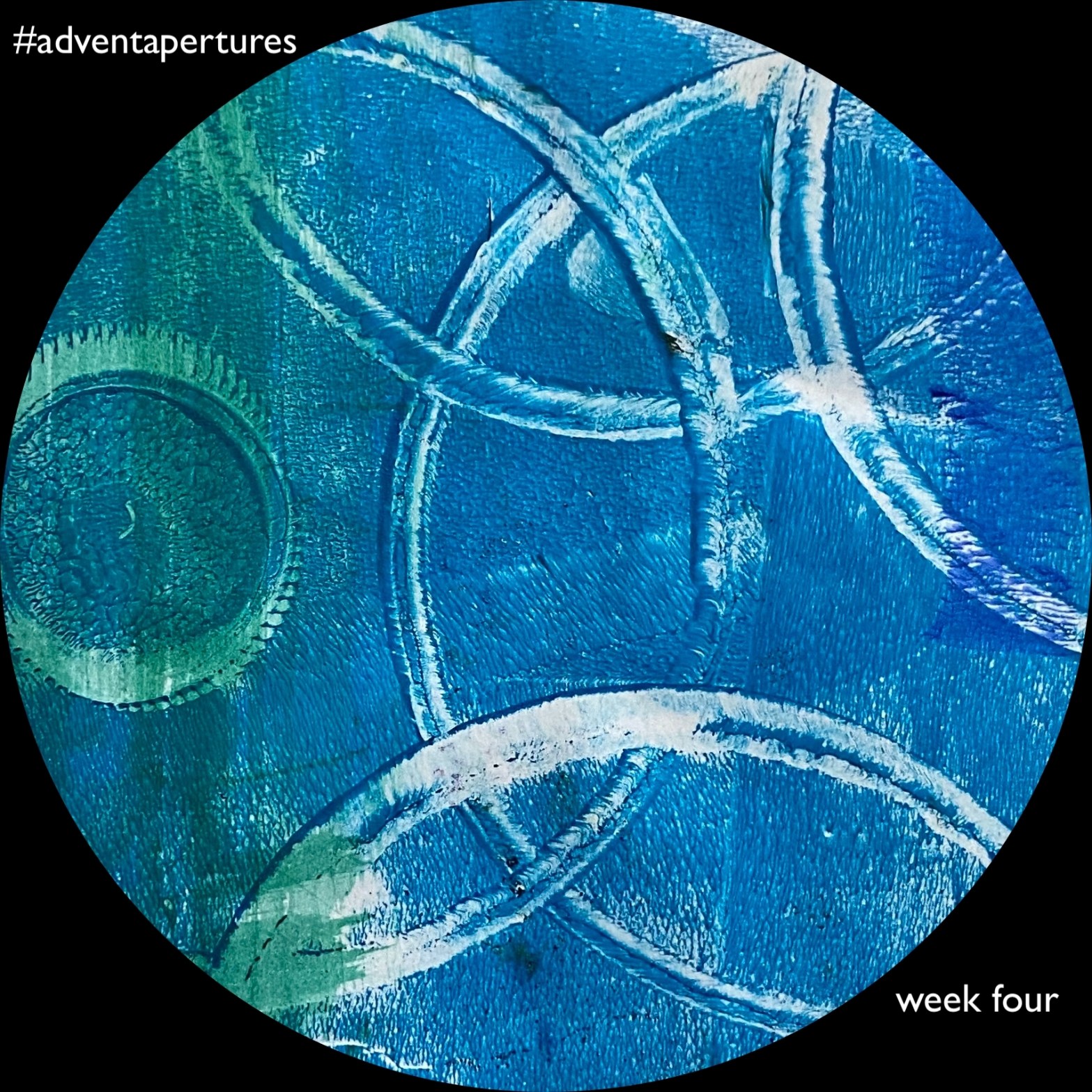
giving GodSelf to GodSelf. (iPhone image)
 image into ikon