It could be the name of a prehistoric beast
that roamed the Paleozoic earth, rising up
on its hind legs to show off its large vocabulary,
or a lover in a myth who gets metamorphosed into a book.
It means treasury, but it is just a place
where words congregate with their relatives,
a big park where hundreds of family reunions
are always being held;
house, home, abode, dwelling, lodgings and digs
all sharing the same picnic basket and thermos;
hairy, hirsute, wooly, furry, fleecy and shaggy
all running a sack race or throwing horseshoes;
inert, static, motionless, fixed and immobile
standing and kneeling in rows for a group photograph.
Here, father is next to sire and brother close
to sibling, separated only by fine shades of meaning.
And every group has its odd cousin, the one
who travelled fo many miles to be here:
astereognosis, polydipsia, or some eleven-
syllable, unpronounceable substitute for the word tool.
Even their own relatives have to squint at their name tags.
I can see my own copy high up on a shelf.
I rarely open it because I know there is no
such thing as a synonym and because I get rattles
around people who always assemble with their own kind,
forming clubs and nailing signs to closed front doors
while others huddle together in the dark streets.
‘Thesaurus’
Billy Collins
For the past ten years I have followed the annual contemplative practice ‘Give me a Word’, suggested by the Abbey of the Arts. It is a process of distilling, of discernment, first practised by the Desert Monks in third century Egypt, whose visitors would ask them for a ‘word’ as guidance over their lives. In 2024 my word was ‘embody/embodied’: a recognition that I live largely in my head, that I have a deeply ambivalent relationship with my (chronically ill/dis-abled) body, my sexuality, my ‘barren’ state, and my body ‘image’. I keep a running note of random thoughts, resources, quotes around the themes of my word as I come across them during the year. Then at the end of each year I use these notes to write a ‘Credo’, a summation of what I have learnt. In doing this, there have been several times that I understood that I had not begun to plumb the depths of my word, and that it needed to be carried over into the next year. Such is the case with ‘embodied’, and I am hoping to write a series of blog posts here about my journey with this word over the coming year (body permitting).
This year, the place I began was with thinking of my body as a home, with that old truth of the body as a temple, as a house for the soul, and how I need to offer my body deep gratitude and radical hospitality. I found some surprising congruence in Gaston Bachelard’s Poetics of Space, which I was reading as part of my research thinking behind the bright-+/well project.* Bachelard draws on Victor Hugo’s character of Quasimodo to draw out themes about the relationship between body, mind, spirit and habitation:
For Quasimodo, he says, the cathedral had been successively “egg, nest, house, country and universe.” “One might almost say that he had espoused its form the way a snail does the form of its shell. It was his home, his hole, his envelope. … He adhered to it, as it were, like a turtle to its carapace. This rugged cathedral was his armor.” . “It is useless,” he continues, “to warn the reader not to take literally the figures of speech that I am obliged to use here to express the strange, symmetrical, immediate, almost consubstantial flexibility of man and an edifice.” (111-2)
Bachelard indicates the primitive nature of this need for refuge by citing the painter Vlaminck, who described ”the well-being I feel, seated in front of my fire, while bad weather rages out-of-doors, is entirely animal. A rat in its hole, a rabbit in its burrow, cows in the stable, must all feel the same contentment that I feel.” In talking about the excellence of animal’s nests as patterns for habitation, Bachelard points his readers toward the proverb (113),
‘men can do everything except build a bird’s nest’
I don’t think of myself in animal terms (except perhaps in relation to spirit animals, which is a whole other conversation), so I don’t often think of my home as a nest. I have at times, considered my body as a snail shell: a cumbersome, slow, heavy carapace for my ‘self’. But if I am going to have a hope of being at home with myself, safe and secure in mind and body, such indivisible wholeness will require the kind of pursuit of wellbeing which Vlaminck describes, which includes care of my physical surroundings as an extension of my body.
It also includes extending the kind of radical hospitality I offer my whole self and my whole house, to others. In The Year As A House: A Blessing, Jan Richardson suggests that I:
Think of the year
as a house:
door flung wide
in welcome,
threshold swept
and waiting,
a graced spaciousness
opening and offering itself
to you.
Let it be blessed
in every room.
Let it be hallowed
in every corner.
Let every nook
be a refuge
and every object
set to holy use.
Let it be here
that safety will rest.
Let it be here
that health will make its home.
Let it be here
that peace will show its face.
Let it be here
that love will find its way.
Here
let the weary come
let the aching come
let the lost come
let the sorrowing come.
Here
let them find their rest
and let them find their soothing
and let them find their place
and let them find their delight.
And may it be
in this house of a year
that the seasons will spin in beauty,
and may it be
in these turning days
that time will spiral with joy.
And may it be
that its rooms will fill
with ordinary grace
and light spill from every window
to welcome the stranger home.
Richardson’s reminders prompt me to remember that the hospitality I offer myself inwardly, needs to be matched by the hospitality I share outwardly – and crucially, vice versa. (As a Church of England Priest’s daughter, I was brought up to always ‘put others before myself’, but never to reflect on the depth and type of love I needed to have for myself before I could offer it to others). For me, I see my home not so much as nest but rather as sanctuary, as haven, as refuge. And I am fully aware that I am projecting onto the brick walls only the kind of care I need to feel inside my body.
The Irish Priest John O’Donohue, meets me at that place inside myself where there is a horrible gap, a wide gulf, a bottomless pit. This has formed out of depressive dissociation between my self image, calcified into something brittle and unlovely over the years, and my True Self – she who is the Beloved of the Divine, who fully inhabits, is at home with and in, her own body. In Eternal Echoes O’Donohue says:
Each one of us is alone in the world. It takes great courage to meet the full force of your aloneness. Most of the activity in society is subconsciously designed to quell the voice crying in the wilderness within you. The mystic Thomas à Kempis said that when you go out into the world, you return having lost some of yourself. Until you learn to inhabit your aloneness, the lonely distraction and noise of society will seduce you into false belonging, with which you will only become empty and weary. When you face your aloneness, something begins to happen. Gradually, the sense of bleakness changes into a sense of true belonging. This is a slow and open-ended transition but it is utterly vital in order to come into rhythm with your own individuality. In a sense this is the endless task of finding your true home within your life. It is not narcissistic, for as soon as you rest in the house of your own heart, doors and windows begin to open outwards to the world. No longer on the run from your aloneness, your connections with others become real and creative. You no longer need to covertly scrape affirmation from others or from projects outside yourself. This is slow work; it takes years to bring your mind home.
I am on that journey of returning ‘home’ to my embodied self. And I suspect that beginning this journey with ‘embodied’ over the past year is the reason why my reflections during ‘#adventapertures 2024:make room’ kept returning to the idea of the Incarnation. That moment when God embodied the GodSelf in flesh and bone and sinew, becoming human, one-with-us. Such a transformation should shake my world-view (and it does!): for suddenly everything that is ever mattered becomes part of the GodSelf (including ‘dark’ matter, seen and unseen), who becomes a part of me. The GodSelf partakes of my body.
Suddenly everything that matters within me is GodSelf too.
May you learn to dwell
Below the surface of the days
At home with the ebb and flow of
Your own heart’s tides.
May you find the womb space at the center of your Life,
There grow wise in the sacred rhythm
Of filling and emptying,
Emptying and filling.
There, held safe,
May you surrender to the unknown
As completely as the dark moon
Empties herself into the secret embrace of her Beloved, the Sun.
There may you cherish hope of renewal
As tenderly as the crescent moon
Cradles the dark in the curve of her arm,
Enfolding, quickening with life new born.
And may you always open to the flow of love
As voluptuously as the moon at full,
Until filled, overflowing, you pour
Love’s gifts out into the world.
So may you grow ever more intimate
With the inward way, the deepening way,
Where filling is emptying, emptying is filling ~
At one with the mystery, at one.
‘A Blessing for the Inward Way’
Tracy Shaw
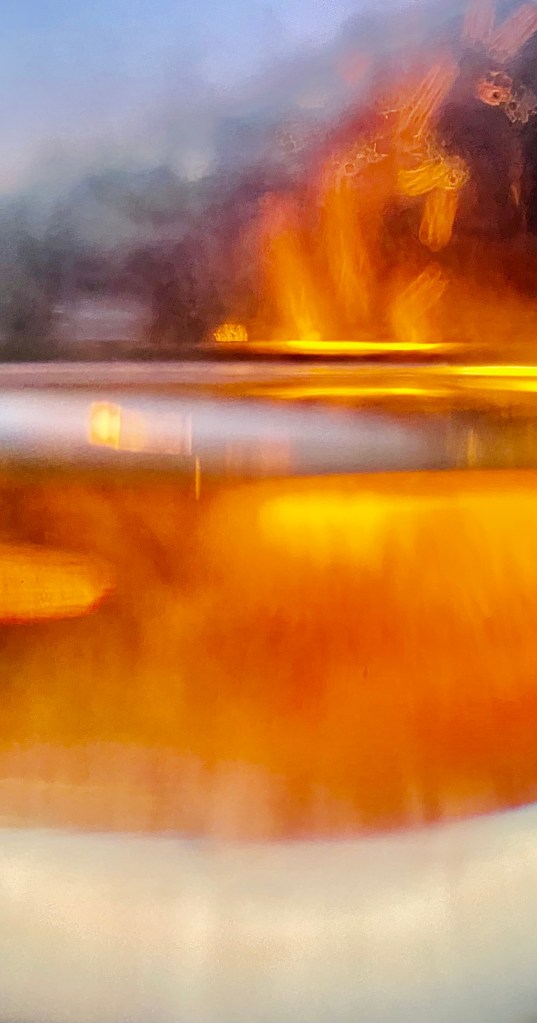
heart tides. (iPhone image)
- If you don’t know about the bright-+/well project, then I wrote a series of blogs about it which can be found here.
 image into ikon
Dear Kate -Thank you aga
LikeLiked by 1 person
Thank you Barbara. All blessings on your 2025.
LikeLike
thank you so much for sharing this journey — this pilgrimage— that “embodied” is taking you on. You write so beautifully.
LikeLiked by 1 person
Thank you so much for this encouragement Bridget. And its been great to have you with me. Blessings on your continued pilgrimage too.
LikeLike
Kate,
Just a quick note of mutual applause and appreciation for Bachelard’s Poetics of Space! How wondrous to think of it overflowing into your Advent posts and outlook.
It was recommended to me a couple years ago by a poet/instructor, and what a wealth of ponderings buoyed me after immersing in the words!
Wishing you a glorious new year of belovedness-in-place as well as in-action, Kate, in all registers of your dear life,
Laurie
>
LikeLike
Laurie, I can’t tell you how much it has meant to me to receive all your encouragement during this Advent. Such generosity has buoyed me in these darkest days of winter, and is spurring me on to share my writings with greater boldness. So (in hope) watch this space …..
Yes, I agree, Bachelard keeps giving! I first encountered him around 2018/19 as recommended course reading when I was doing an art course on drawing space and place. Fascinating. Have you read ‘In Praise of Shadows’ by the Japanese essayist Tanizaki? Another text to which I keep returning (though there are so many those) and my ‘to read’ book pile for 2025 is already teetering on my bedside table…
Praying all blessings on your becomingness, in whatever surprising and familiar forms it takes this year: may you know you are gift at all times and in all places dear one. K
LikeLike
Thank you, Kate, for that extraordinary blessing and affirmation. ❤
And for the book recommendation. I just ordered the Tanizaki title from our library system and will look forward to immersing in it.
I read this and thought also of you and your radiant seeing and work/play dynamic—despite health interruptions and limitations:
(from Sarah Clarkson, Reclaiming Quiet)
"I have come to deeply believe in the past ten years of spiritual excavation [that] escaping the ordinary is no escape. If I cannot find 'earth crammed with heaven' in the forced bulb growing in winter on my windowsill, I will not find it in whole fields of blossoms in abandoned, springtime wandering. I truly believe it's amidst our ordinary stuff that the divine affection cradling our lives is both revealed and enfleshed: in our fierce little acts of kindness, in our humble creations, in moments of intricate and miniature beauty or words offered like water in the tiny deserts of our individual loneliness.
"And yet.
"There is a potent grace in spaces of suspension when the pilgrim nature of our lives finds expression in a period of seeking. We're all born hungry, so hungry. We don't always remember this, but the broken world around us was never the one for which we were originally made. At the back of our happiest moments here is the haunting strain of a music that draws us onward, beyond any good we have ever known.
"Our hunger is integral to our discipleship."
LikeLike
Laurie, this is deep truth, isn’t it? This is talking about discipleship made up of the discipline of holding together those Kingdom paradoxes – the both/and of life, the now/not now, the here and the there, the last, the first. We pick our path through our unbelief, our grief, trying to make the minute corrections which balancing requires (to be as well, as whole as we can in that moment), so that we might have just a moment, one iota of a second in the day where we can lift our heads and do some beholding – see the divine at work in the fallow and the bounty, in the shadow and the blaze, in the community and in the solitude, in the ordinary and the graced extraordinary…
Your comment also contained two of my current serendipidity words – you know the ones that keep recurring, asking you to take notice! – so thank you: enfleshed and limitations. Both are requiring active thought and prayer in me, and of course, will result in some writing at some point…
Let me know if there’s ever anything specific I can pray over for you – email me at katekenningtonsteer@gmail.com. Love and Blessings xx
LikeLike
And the Richardson blessing!
And a Kempis and O’Donohue and Collin . . ..
We love so many of the same wisdom writers!
>
LikeLike
somehow this is not a surprise dear Laurie!!!!!
LikeLike