Totally conscious, and apropos of nothing, you come to me.
Is someone here? I ask.
The moon. The full moon is inside your house.
My friends and I go running out into the street.
I’m in here, comes a voice from the house,
but we aren’t listening.
We’re looking up at the sky.
My pet nightingale sobs like a drunk in the garden.
Ringdoves scatter with small cries, Where, Where.
It’s midnight. The whole neighbourhood
is up and out in the street
thinking, The cat burglar has come back.
The actual thief is there too, saying out loud,
Yes, the cat burglar is somewhere in this crowd.
No one pays attention.
Lo, I am with you always means when you look for God,
God is in the look of your eyes,
in the thought of looking, nearer to you than your self,
or things that have happened to you
There’s no need to go outside.
Be melting snow.
Wash yourself of yourself.
A white flower grows in the quietness.
Let your tongue become that flower.
Jalaluddin Rumi (translated by Coleman Barks)
In her article, Reframe the Picture, Shanti Natania Grace relates the following anecdote:
When John F. Kennedy visited NASA in 1962 he talked with many people there. Each one told him about their jobs, with various details of the day-to-day. But when he met a janitor in the hallway and asked him what he did for NASA, the man replied “I’m helping put a man on the moon.”
Each day we have the opportunity to understand and reframe our thoughts and perspectives. We tend to have a running monologue describing and evaluating who we are and what we are doing, and we seldom stop to question it. Then we relate to ourselves and others through the frame of that description. Yet it’s always possible – and often much more accurate – to reframe the description in other ways. Reframing is not a denial of the facts, it accepts the actuality of whatever’s going on and then expands the view to include a wider picture.
The man who replied “I’m helping put a man on the moon,” framed his work in a larger context; he valued himself and his contribution, and he saw the truth of the interdependence and value of everyone who worked there.
Making room for reframing means stopping and questioning my own perspective, and acknowledging my own blinkers, filters and prejudices. My default viewpoint, where ‘I’ am the subject of every moment, where everything revolves around ‘me’, gets challenged when I read about the deep listening practised by Pauline Oliveros, for example:
When you enter an environment where there are birds, insects or animals, they are listening to you completely. You are received. Your presence may be the difference between life and death for the creatures of the environment. Listening is survival.
To be ‘received’ by a bird is humbling. I wonder what it is like to be received by an angel?
Here, in ‘The Spirit of Elijah (Luke 1.14-18), Drew Jackson writes of the angel Gabriel and the prophets that confront injustice with God’s healing power:
I’ve been told that God shows up
on shores, in boats, with Bibles
and swords.
I’ve been told that God does
the bidding of kings
seeking to plant their flag on my soil.
I’ve been told that God snuggles up to
power that delights to
kill bodies like mine.
But that’s not what Gabriel said.
Gabriel said that God’s prophet
will have the spirit of Elijah,
bringing life to widows’ households.
Gabriel said that God’s prophet
will possess the power of the Tishbite,
tearing down monuments to the god of domination.
Gabriel said that God’s prophet
will be filled with the Holy Spirit,
committed to speaking out against Ahabs and Jezebels.
Thus saith the LORD.
Gabriel certainly challenged Zechariah’s point of view by telling him that he would be the father of John the Baptist. Later in Luke 1 Gabriel is sent to Mary, telling her she was to give birth to the Christ. That rocked her worldview, to put it mildly. In Luke 2, angels freak out shepherds above Bethlehem, telling them where to find God, thus changing their lives for ever. The God-Who-Comes needs me to make room in my tiny mind and to prepare to be shocked out of what I think I know, if I am to even glimpse even an iota of the truth about how the God-Who-Is, is the God-Who-is-Coming; about how the God-With-Us will be with me for all time.
Am I ready?
She was young,
but not too young to know.
She would have seen the soldiers
marching along the road.
She would have heard, late at night, the elders
still spinning the old tales –
slavery; liberation; exile; oppression.
She would have listened to the whispers
of a final redemption.
I wonder if she believed –
if such rumours of light could take flight
after such long and bitter centuries?
I wonder how she felt
when she was told.
‘Mary’
Gideon Heugh
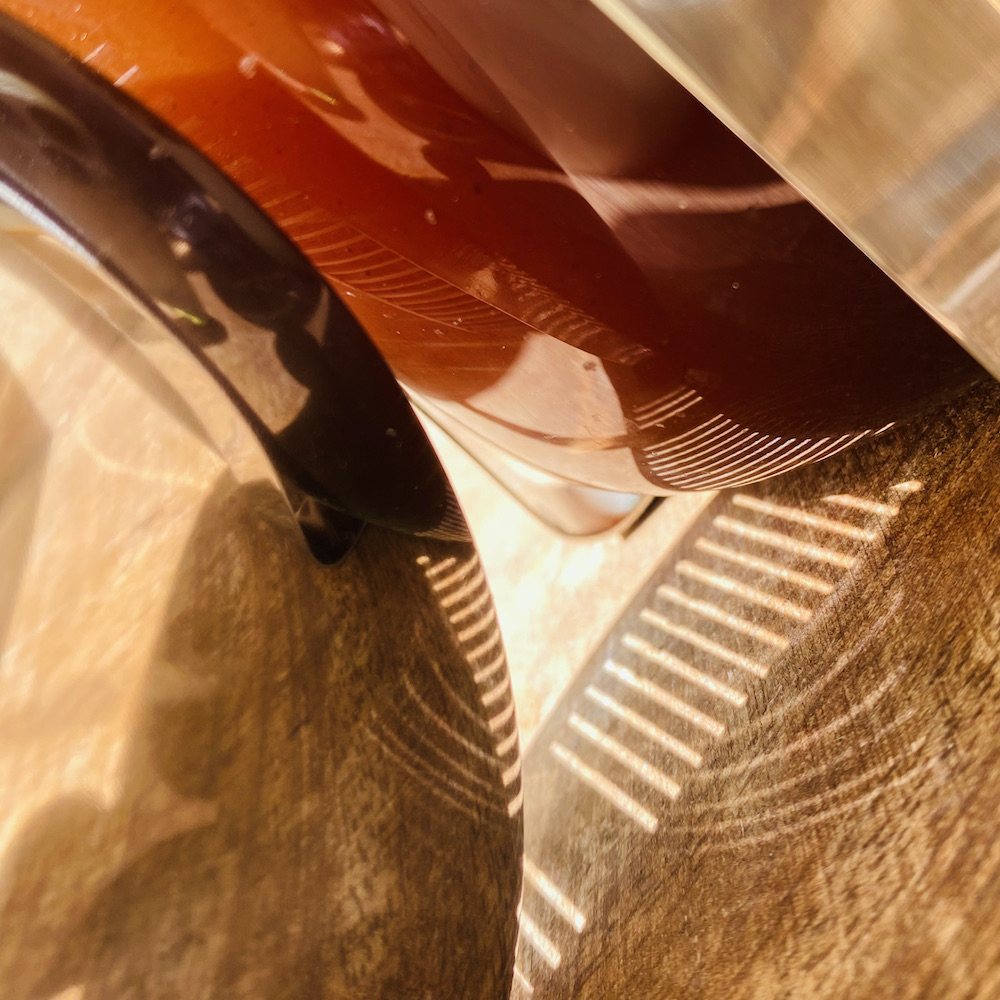
questioning the running monologue. (iPhone photo)
 image into ikon