Grief is a response to an irreversible loss… To generate grief rather than sadness, the thing lost must carry great emotional weight, and it must pull back the veil that covers a transcendent aspect of the world. Breathe out to push the fog away from a brilliant pinpoint of light. … Gravity holds my feet on the ground. Gravity keeps the earth traveling around the sun, the sun dancing around the galaxy, the galaxy threading through the Local Group, and on and on. Gravity pulls rain out of the sky. And snowflakes. And leaves in autumn. And tears from my eyes when I knew you really are gone. Where did you go?… The distance between here and there is the answer to the wrong question. …I thought gravity pulled my mind into the past, stuck in memories. But now I know I can’t trust memories. Some are invented, all are edited. The whole web of who I am — what I’ve seen and done, what skills I’ve found — is nothing but fog. Gravity pulls me to the future, bits of me falling off along the way. Each of us disappears into the mist of the possible. In our minds, time is gravity’s other side.
Michael Frame, Geometry of Grief
During this past year, regular readers of this blog will know that I’ve been working on the bright-+/well project, looking at wellbeing and the built environment. This year’s Advent theme, ‘make room’, partly arose from that too. As a result of my research, I have been made very aware of all that has been demolished and knocked down and destroyed in the last year – whether that is a home, a community, a neighbourhood, a city, a country – whether that is through commercial development, war or ecological disaster. I am also aware that institutions and values are also being undermined through a wide variety of causes – whether that is democracy, the United Nations, or the Church of England and Anglican Communion. Many people have been left without a place of safety, a home, or a community to which they can feel they ‘belong’, or have been left feeling ‘stripped’ of frameworks from which they previously drew strength.
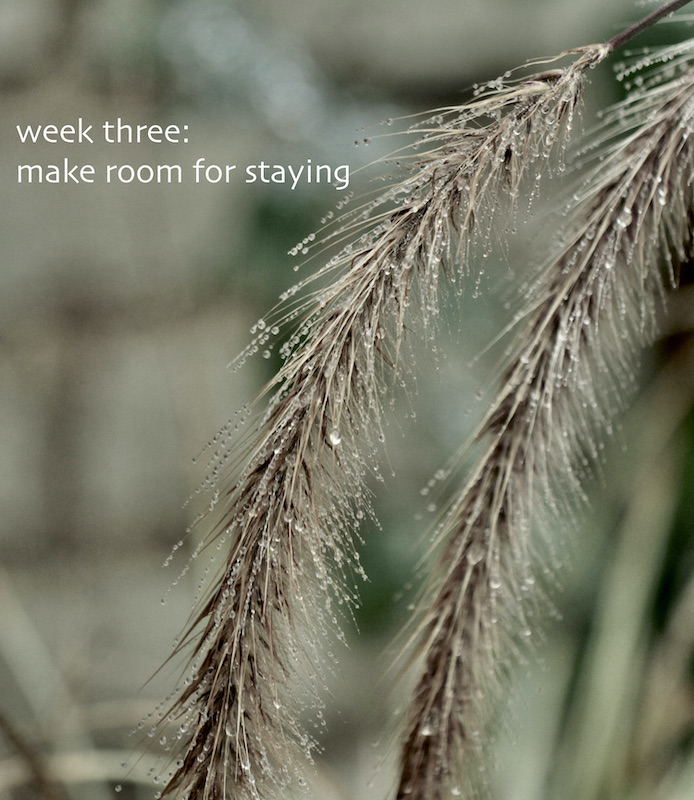
One of the reasons of writing this series then, is the need to ‘make room for…’ a whole host of values – whether that be as individuals – internally, emotionally, physically, spiritually, mentally – or as a community. Part of making that room is about thinking in detail in physical as well as metaphorical terms about what we build as a society, as well as for whom and for why and how. But before I can build, I have to acknowledge the empty space, to see what was lost, why, how and by whom. Making room to grieve all this is vital.
Today is the Winter Solstice, the Shortest Day where it feels like darkness might overwhelm light. In response I have adopted the tradition of celebrating Blue Christmas on this day: for all those who are (or feel) alone, who are (or feel) homeless, who are grieving, are desperate, are sick, are (or feel) powerless.
When I mourn no one can tell me how long I will need to grieve. No one can tell me the depth of my grief. No one can rush me into a spiritual bypass, that tells me the time for mourning is over. Mourning is a part of living the both/and of life – every minute someone is mourning just as someone else is dancing – to a greater or lesser degree. Mourning is an acknowledgement of loss at the same time as recognising that life continues. Grieving is entering the unknown: willingly entering into, rather than resisting, a time I want to flee from; willingly remaining present during a time every fibre in my being tells me I do not want to undergo. Howard Thurman, the American Civil Rights Leader, Baptist Minister and theologian put it like this when he wrote the prayer/poem ‘I will Light Candles’ during the 1950s:
I will light candles this Christmas;
candles of joy despite all sadness,
candles of hope where despair keeps watch,
candles of courage for fears ever present
candles of peace for tempest tossed days
candles of grace to ease heavy burdens
candles of love to inspire all our living,
candles that will burn all the year long.
Thurman encapsulates the courage that’s needed to live the both/and. To make room for grief, then, is to make room for the sudden delight that might emerge. It may not touch the feeling of grief, and yet, I am changed by the arrival of something I need to pay attention to in that moment. The novelist/essayist Barbara Kingsolver wrote ‘My Desert Pond’ about being willing to make room for these moments of encounter with the both/and of life:
What to believe in, exactly, may never turn out to be half as important as the daring act of belief. A willingness to participate in sunlight, and the color red. An agreement to enter into a conspiracy with life, on behalf of both frog and snake, the predator and the prey, in order to come away changed.
‘A willingness to participate in sunlight’ may or may not ease my actual feelings of loss, but what the Shortest Day/Longest Night demonstrates is the infinitesimal gradations that it takes to achieve balance. It shows us that change always comes. This moment I am full of grief, the next moment I am full of aliveness that a change in the quality of the light can bring out in me. Both are equally true. I live in the messy, unknowing place, making room for grief and whatever needs to show up in me in the next second, the next day, the next year.
The point about Christmas is that God-With-Us lives here too.
‘Lesson i’
The desert is powerless
when thunder shakes the hot air
and unfamiliar raindrops slide
on rocks, sand, mesquite,
when unfamiliar raindrops overwhelm
her, distort her face.
But after the storm, she breathes deeply,
caressed by a fresh sweet calm.
My mother smiles rainbows.
When I feel shaken, powerless
to stop my bruising sadness
I hear My Mother whisper:
Mi’ja*
don’t fear your hot tears
cry away the storm, then listen, listen.
‘Lesson ii’
Small, white fairies dance
on the Rio Grande. Usually they swim
deep through their days and nights
hiding from our eyes, but when the white
sun pulls them up, up
they leap about, tiny shimmering stars.
The desert says: feel the sun
luring you from your dark, sad waters,
burst through the surface
dance
Pat Mora, from Chants (1984)
* Mi’ja is Spanish for ‘my daughter’

a room for what is gone. (iPhone image)
 image into ikon