Consider this. In the shadow of a perfectly round object, you will find a rebellious glimmer of light – a bright spot in the middle. I’m not being metaphorical here. I really mean to queer the essential and disturb its eminence. What better way to do it in this case than to point to light at the heart or darkness, and vice versa. … this phenomenon points to “diffraction”, which literally means “breaking up.” I like to think of it as a porosity – that there is such a primal mutuality between “things” that nothing “becomes” unless it “becomes-with”.
When the inventor of the word ‘diffraction’, a seventeenth-century physicist and Jesuit priest Francisco Grimaldi, directed a focused ray of sunlight into a dark room, managing the ray so that it struct a thin rod and produced a shadow on a screen, he found that ‘the boundary of the shadow [was] not sharply defined and that a series of coloured bands [lay] near the shadow of the rod. Up till then, the general views established that light waves interacted with surfaces by reflection and refraction. …When Grimaldi performed his experiment … it was as if the light bent around the edges of things to form fuzzy edges and coloured bands, … ‘diffraction fringes – bands of light inside the edge of the shadow. Bands of light appear inside the shadow region – the region of would-be darkness, and bands of darkness appear outside the shadow region.’ … Grimaldi’s work already showing that ‘there is no sharp boundary separating the light from the darkness: light appears within the darkness within the light within.’ In fact, ‘darkness is not mere absence … [It] is not light’s expelled other, for it haunts its own interior.’
This true for everything physical. Nothing is complete; everything undergoes a “breaking up” in its co-emergence with “other things” … there are no “sides”.
Gloria Anzaldu writes:
There is darkness and there is darkness. Though darkness was ‘present’ before the world and all things were created, it is equated with matter, the maternal, the germinal, the potential. The dualism of light/darkness did not arise as a symbolic formula for morality until primordial darkness had been split into light and dark. Now Darkness, my night, is identified with the negative, base and evil forces – the masculine order casting its dual shadow – and all these as identified with dark-skinned people.
Bayo Akomolafe, These Wilds beyond our fences, (210-211)
Making room for darkness* is, I believe, an essential in any spiritual journey, and one so very few people talk about. Evangelical or charismatic Christianity is sometimes so bound up in its certainty about God as Light and Love, that pilgrims are ill-equipped when they hit the hard, faith-shaking stuff of life, where they cannot perceive God’s benevolence. This is then described as ‘dark’, which just perpetuates the either/or belief in light as a good, as a blessing, leaving dark as an evil. Evil undoubtedly exists, but it does not have to be associated with darkness. Culturally, I am taught to fear ‘what goes bump in the night’, what violence might take place ‘under the cover of darkness’.
Yet if God is God of all, then God is as much dark as light. How much do I know this God of the Dark? This holy, mysterious, God-for-Whom-I-wait? What difference might it make that I have to wait through the darkest time of the year (in the Northern hemisphere)? This is the God of ‘diffraction’, where the light is inextricable from the darkness. Both are, scientifically and spiritually, together. One cannot be without the other. This God who comes to ‘be with’ me, Emmanuel, then, is with me equally in dark as in light. I cannot turn away from the God of the Primordial Dark, if I want to believe in the God of the Resurrected Light.
So much of my spiritual pilgrimage feels like it takes place in the dark, where I can’t see a path to follow, where I feel overwhelmed with the needs of so many who suffer in our world, where I ask and ask for mercy and seem never to be given healing, where my depression is thick and feels opaque and never-ending.
And yet.
All my life, I can look back and testify, that I have always, without fail, found I meet the God-of-the-Dark eventually. I receive the comfort I need, the reassurance I seek, the acceptance I crave. Always, but always, I never notice where dark becomes light, but travel on along the fuzzy edges, navigating them as creatively and prayerfully as I can.
As Wendell Berry notes in his poem ‘A Native Hill’, ‘I have thrown away my lantern, and I can see the dark’. I pray for such night-sight to see the God who is with me in the becoming of all things, as all living things emerge light-with-dark, dark-with-light, together. I pray for such dark-sight to stand still in the shadows, when it feels as if all I know is breaking apart, and to have the courage to keep looking for that bright spot, which will never be where I expected to find it. I pray for such night-sight so that, like Jeannette Winterson below, I can ‘be where I like to be in my mind – which is dark without being melancholy, brooding without being depressed’. I ask for the grace that I will get to know the God-of-the-Dark equally as well as the God-of-the-Light, that I will then be able to stop calling God Light Or Dark, but simply the black-sun I AM of all things.
It’s human to want light and warmth. …Electricity’s triumph over the night keeps us safer as well as busier. But whatever extends the day loses us the dark. We now live in a fast-moving, fully lit world where night still happens, but is optional to experience. Our 24/7 culture has phased out the night. In fact we treat the night like failed daylight. Yet slowness and silence – the different rhythm of the night – are a necessary correction to the day. I think we should stop being night-resisters, and learn to celebrate the changes of the seasons, and realign ourselves to autumn and winter, not just turn up the heating, leave the lights on and moan a lot. Night and dark are good for us. As the nights lengthen, it’s time to reopen the dreaming space. Have you ever spent an evening without electric light?
…I have noticed that when all the lights are on, people tend to talk about what they are doing – their outer lives. Sitting round in candlelight or firelight, people start to talk about how they are feeling – their inner lives. They speak subjectively, they argue less, there are longer pauses.
To sit alone without any electric light is curiously creative. I have my best ideas at dawn or at nightfall, but not if I switch on the lights – then I start thinking about projects, deadlines, demands, and the shadows and shapes of the house become objects, not suggestions, things that need to done, not a background to thought. The famous ‘sleep on it’ when we have a dilemma we can’t solve is an indication of how important dream time is to human wellbeing. The night allows this dream time, and the heavier, thicker dark of winter gives us a chance to dream a little while we are awake – a kind of reverie or meditation, the constellation of slowness, silence and darkness that sits under the winter stars.
… It is a mistake to fight the cold and the dark. We’re not freezing or starving in a cave, so we can enjoy what autumn and winter bring, instead of trying to live in a perpetual climate-controlled fluorescent world with the same day-in, day-out processed, packaged, flown-in food.
I have a tiny woodburning stove on my girlfriend’s balcony in London. She thinks I’m crazy, but I like to sit in front of it with the lights of the city elsewhere, heating a pan of soup or roasting chestnuts, and yes, I could do that on her fancy Falcon cooker, but I wouldn’t be where I like to be in my mind – which is dark without being melancholy, brooding without being depressed.
Food, fire, walks, dreams, cold, sleep, love, slowness, time, quiet, books, seasons – all these things, which are not really things, but moments of life – take on a different quality at night-time, where the moon reflects the light of the sun, and we have time to reflect what life is to us, knowing that it passes, and that every bit of it, in its change and its difference, is the here and now of what we have.
Life is too short to be all daylight. Night is not less; it’s more.
Jeanette Winterson, ‘Why I adore the night’, The Guardian, Saturday 31 October, 2018
- I will say again, as I always try to when I write about darkness, that I in no way equate dark or darkness with racial ‘blackness’, nor do I endorse any kind of value judgement on ‘dark-skinned’, BAME people. I am deeply sorry for all the historic racial slurs that Christianity has helped to perpetuate, and for all the hurts caused by language which casually embraces dualistic thinking and a colonial, unjust past. I try my best not to continue any of these, but know I will inevitably offend some. I pray you will forgive me, and point out to me where I am wrong.
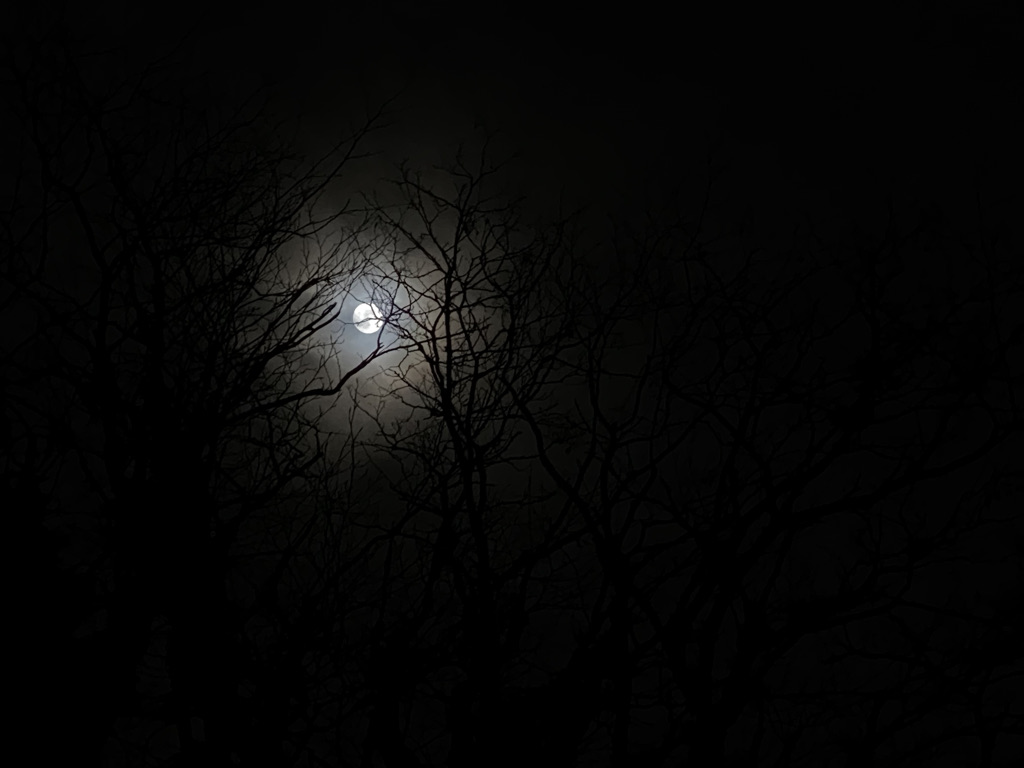
darklife. (iPhone image)
 image into ikon