
We dance round in a ring and suppose,
But the Secret sits in the middle and knows.
‘The Secret Sits’
Robert Frost
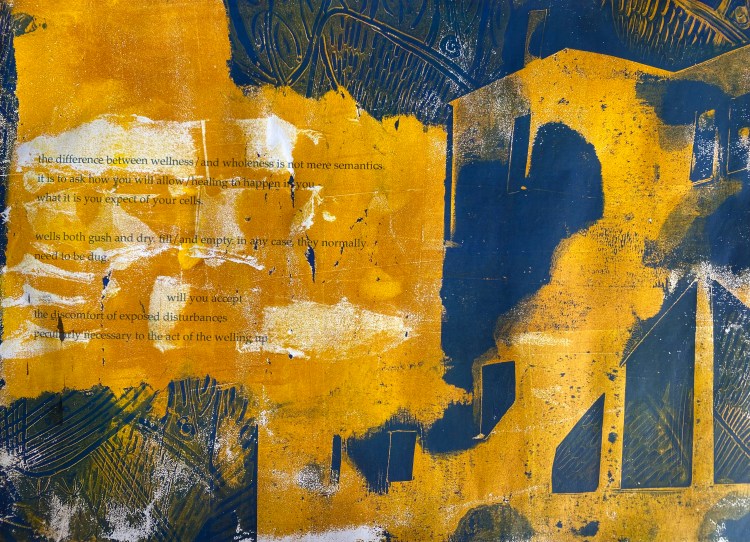
For as long as I can remember, I have been fascinated by the idea of essence: that there is a core, a kernel, a seed, a heart, a soul, which functions as a (potentially discoverable) centre of meaning in every object or person, subject, idea or experience. This fascination persists, even though I have adopted all kinds of intellectual theories along the way about how meaning is made, changed and multiplied; or for that matter, how the GodSelf defies being deconstructed into a disappearing infinity.
Although ‘visible’ work on the bright-+/wellproject has been in a prolonged hiatus due to four and a half months of back-to-back viruses, a regular check-in with my original vision kept confirming a kind of excited urgency at what I and the local community might do together to unearth whatever meanings might underlie this place. (see footnote)
I want to interrogate the names that the people who have lived and worked and visited here for centuries, have given to the land and its distinguishing features. This goes beyond the Shakespearian question ‘what’s in a name?’ (Romeo and Juliet (II.ii)), since I’m trying to peel back the layers of history lying behind and between words and place, and/or names and people. Through combinations of poetry, photography, printing and painting I want to connect how and why we name places, and how the names we use shape the very land and the ways we use it – and so, in turn, we too are shaped.
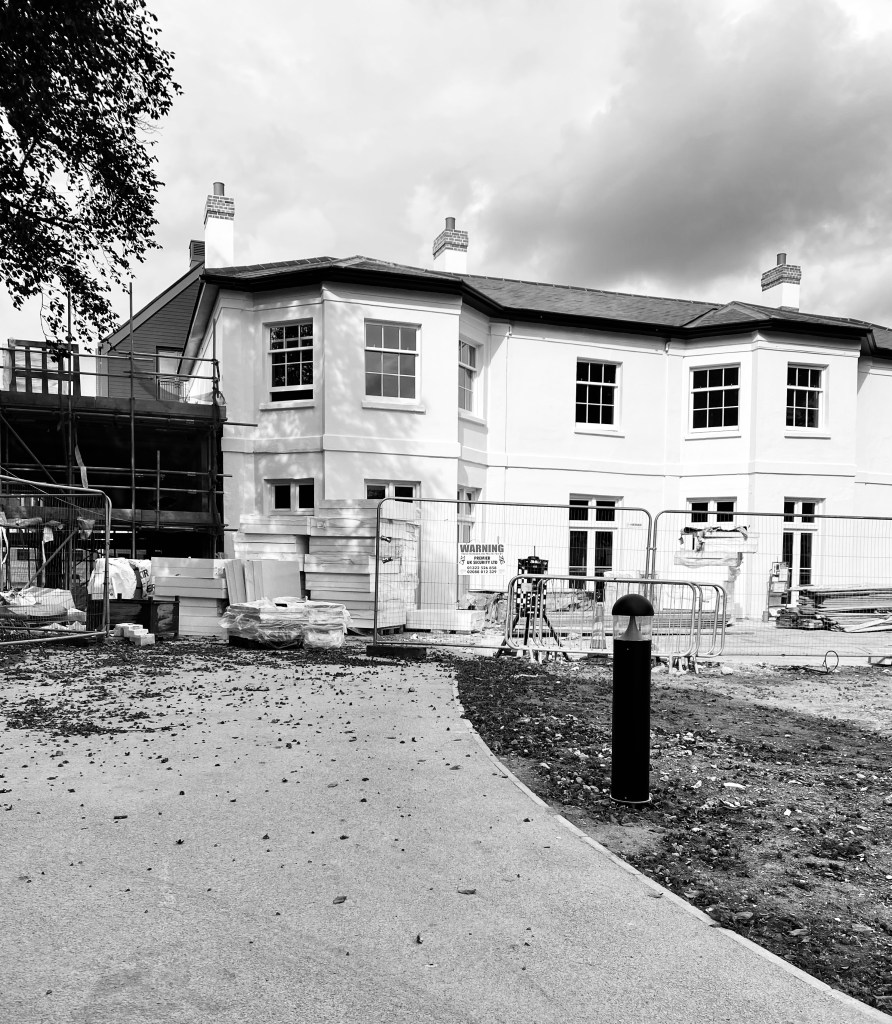
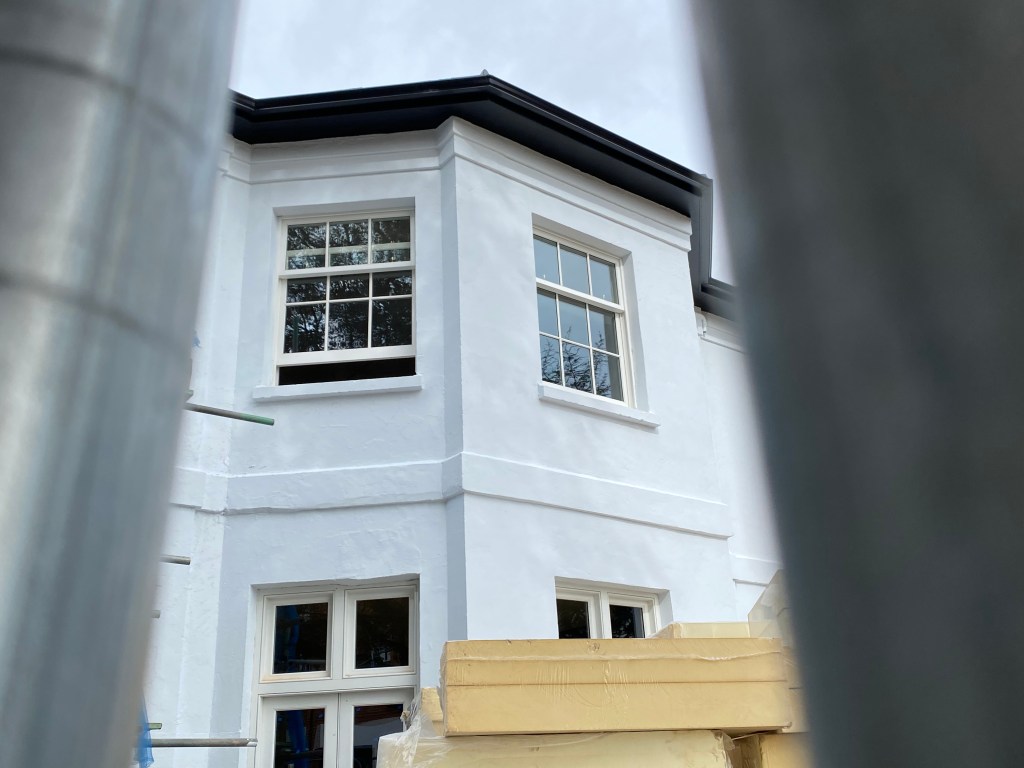
Take for example, how the name BrightWell – given in 1905 to a grade II listed house built in the 1790s – is suggestive to an architect in 2023 as they interpret (shape/meet) the needs of people and place. The name ‘BrightWell’s Yard’ allows the architect to conjure up a neologistically-imagined ideal: it configures the new with a design nod to the old, projecting an aspirational mode of living, but arguably, one without more than a fleeting consideration for sustainability and developmental impact on the local, if not global, landscape. As a result, BrightWells Yard runs the danger of being a mixed residential and commercial site which is out of date before it is even fully finished being built. So how can this place be luminous or refreshing or even, as the ‘Yard’ suggests, lightly industrious and honestly creative?
It is easy to be cynical. It is too easy to conjure up Crest Nicholson PLC as the big bad developer, or indeed to see BrightWells Yard as a classic example of bad corporate design. Instead, I want to uncover so that I can discover, and perhaps, recover, what meanings this area of town may have lost, when generations, driven by the desire for commercial gain, have been hastily tearing down the seemingly ugly, unloved or unuseful, in order to rebuild the seemingly purposeful in its place.
There were times last summer where I felt I was bit like a ‘lone voice in the wilderness’, trying to invite developers, designers, residents, workers and visitors alike to come visit me in my open studio, so that person by person, brick by brick or tile by tile, connections can be made; so that a community might be gathered together to imbue this new iteration of a place, ‘BrightWell’s Yard’, with positivity and vision.

My vision for this place? It’s about the well and the hole in the ground, about the wellness and the wholeness. It’s intensely personal and completely communal. It’s a holistic, imaginative daydream for social, political, spiritual and environmental justice.
In part i of this post I wrote:
“In my fanciful terms, the combination of these derivations and usages
means that wellbeing comes to mean something like
an abundantly rising, bubbling, source of healing to be drawn upon, which makes one whole.
And if that source is available in this place,
then what meanings do the various usages of the word ‘bright’ add?”
I am so honoured that the bright-+/well project is allowing me to have all sorts of conversations with people who are serious about living these nuances.
Next time, let’s follow the water …
the difference between wellness
and wholeness is not mere semantics.
it is to ask how you will allow
healing to happen in you –
what it is you expect of your cells.
wells both gush and dry. fill
and empty. in any case, they normally
need to be dug.
.
in the subaqueous lightwell
– murkwell – cast by green umbrellas
already spread through the morning’s
cypress shadow, I sit, considering
a way out, a passage through,
which can only ever mean downward
work, if I am to excavate another fragment
of clogged bedrock; if I am to accept
the discomfort of exposed disturbances
peculiarly necessary to the act of the welling up;
if I am to feel the streaked pain and loose pulse
as my essential lifejuice rushes through silt,
eager to frolic again with sky.
for those who do care
for land and lilt and life alike, let the words come
thick and strong and oozing; a mortar to spread through,
sink under, squeeze, surround and soak up the spaces,
those pockets where grief lives deep; condense
the tears together; and let the joining
be the healing.
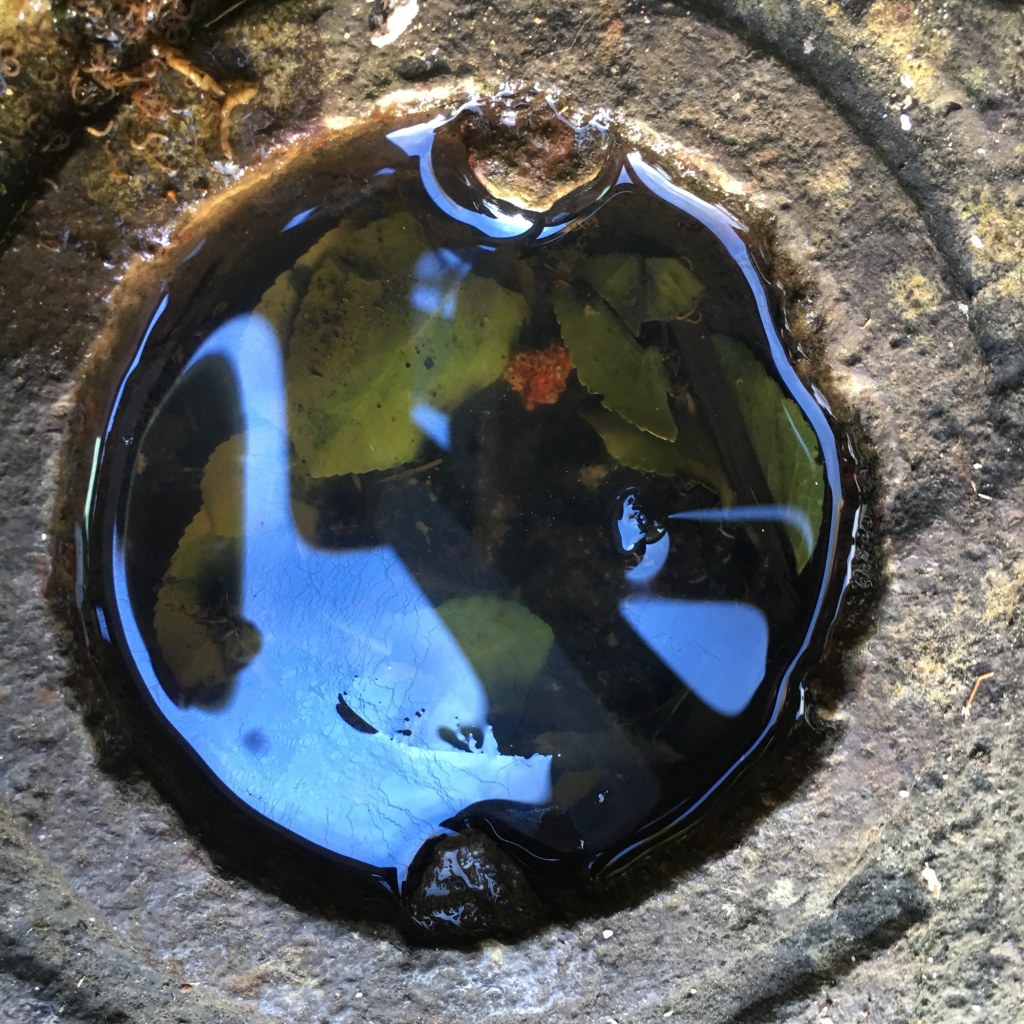
footnote: the bright -+/well project:
I am experimenting with ways to combine, layer and merge photography, painting, printing and poetry around four main themes:
- how a single space/place changes through time;
- how the people of each era leave their vestigial marks on the landscape;
- how the act of building an urban environment affects the well-being of those whose labour crafts our homes, shops, offices;
- as well as how the finished built environment affects the wellbeing of those who live in, work at, or visit to, that place.
I am exploring these themes with reference to a single place: a new town-centre, mixed commercial and residential development by Crest Nicholson PLC, named BrightWells Yard in Farnham, which has a Grade II listed Georgian house called BrightWell at its heart, in which I used to work in 1998, when it formed a part of the Redgrave Theatre.
 image into ikon